Showing posts with label Featured Guns. Show all posts

Sunday, May 16, 2010

NRA Convention Gun P0rn

One of the things Yosemite Sam and I always do at the convention is drool over guns. There were many to choose from:

A Whitney Wolverine from the 1950s; so Buck Rogers, so ahead of its time.


From Buck Rogers to Queen Anne's time. These were from an exhibit of Hugenot made guns.

An early Thompson sub-machine gun.

It wasn't all guns, you could buy grips, knives, optics, clothing, tactical underwear (literally), and more.

No that's a gun; a Taurus chambered in .45 LC or 410 shotshell.

Okay, one more.

We saw pink guns, gold guns, blank guns, tan guns, but here's a spangled red, white and blue gun.

Wednesday, January 27, 2010

Collecting and Taking Guns Apart

I haven’t mentioned my collecting activities as of late. I guess this is time to unveil my newest purchase.

A rifle, the Swiss Schmidt-Rubin 1896/11 bought at Collectors Firearms in Houston, Texas while I was on a trip for family business. I haven’t taken it apart yet for cleaning and it was missing a magazine, but the price was decent and it fills a gap in my collection. Besides, somehow or another I’d already acquired the proper bayonet for it. Now I have the gun that fits the bayonet. Pictures and commentary will follow.

My collection activities are slowing down lately. I’ve acquired most of the guns that fascinate me. That’s not to say there aren’t more out there. There are always more. It’s just that I’ve bought those guns I’ve wanted to own.

I may need to expand my horizons. For instance, I prefer handguns over rifles (most of the time) and semi-auto pistols over revolvers. The mechanism of a pistol is so much more interesting to me than that of a revolver. You see, I take all my guns apart, basically to the screws. There are a few sub-assemblies that have daunted me in the past. But, the Internet now has disassembly/reassembly instructions for almost every gun imaginable and I bull forward with my punches and screwdrivers. What can’t the Internet do?

Because I take my guns apart, I see how the fifty-odd parts (sometimes more, sometimes less) intermesh to operate that firearm. It must be something like the thrill a gearhead has when he (or she) takes an old and cranky engine apart, fixes it, and reassembles it into something that purrs like an overgrown kitten. Guns are my gearhead fix.

I have taken revolvers apart and I do get some of that thrill, but for me the semi-auto rocks. Some have cams machined into the barrels, others have a cam attached to a little ear (looking at you John Moses Browning’s 1911).

Some you take apart by pushing the slide back just so and then jiggering the barrel until a slot aligns with a groove. Others you have to hold together while you slowly separate the parts lest a spring launch itself into the air, bounce off your forehead, and roll under the heaviest piece of furniture you own.

There are even some that are a true jigsaw puzzle of intricately machined parts that lock into place without benefit of pins or screws. I love broomhandle Mausers and already own three of them—more please.

So, do I expand my horizons? That’s the question. That will mean more “Ones From the Vault” (and I have guns that aren't featured on the site). That will mean more money diverted from unnecessary items like food toward the truly necessary like guns. Decisions, decisions.

Thursday, May 21, 2009

More Gun Pics

Here's the second installment of some gun p0rn taken at the NRA Convention. Enjoy.

Engraved Henry Rifle
A small selection from a wall of Lugers

Yet another wall of guns, these were old military flintlock and percussion pistols

Shiny 1911s

A future gunnie with a bulldog Gatling


Finally, for the reloader who has a taste for serious cartridges, a Dillon reloading press for .50 cal BMG. That thing will give you an aerobic workout and a complete cartridge at the same time.

Time date is for Mountain Standard Time

Thursday, January 08, 2009

Manly Guns II

As Josh indicated in comments to my last post, "Crazy Einar" posted a new list of manly guns (at least they're new to me). This one includes the famous M1 Garand as the second most manly gun. The manliest is the Browning M1919A4 belt-fed machine gun. No argument from me on that score.

This new list includes several esoteric guns. I've never heard of the .600 Overkill cartridge. I'd like to shoot one but only if someone's available to re-socket my shoulder joint.

Yosemite Sam and I own five of the guns on the list and, no, we don't own a Browning M1919A4. More's the pity. Once again Crazy Einar has created a very interesting and enjoyable list.

Crazy Einar identified himself this time as Michael Z. Williamson. Knock me over with a feather. I've read his Freehold series of books and enjoyed them immensely. They're good gunnie reads. There are several other books listed in his site's bibliography that I haven't read. I sense an Amazon order in my future.

Wednesday, January 07, 2009

Manly Guns

Via Say Uncle, we get a list of the manliest firearms written by “Crazy Einar.” It’s an excellent list as these things go. I do have some quibbles about it though.

The M1 Garand must be included. One of the manliest men ever, George Patton, called it the greatest battle implement man has ever made. Our soldiers used it to defeat the Germans, Italians, and Japanese. It shoots a 30.06 round, which is loud, hard-hitting, hard-recoiling and, well, manly. I would replace the Swiss K31 with the Garand. Now, I like the Swiss rifle. We own one and have shot it often. It’s a great gun, but something has to give.

I‘m tempted to suggest replacing the S & W Model 29 with that company’s .500 Magnum. After all, the .500 is now the most powerful handgun in the world. It fires a truly manly handgun round. I’ve shot one a few times in an indoor range and everyone stops to see what the big noise is all about. And its recoil is not for the faint of heart. However, Dirty Harry used the Model 29 and for that reason alone must stay on the list.

I’m not a fan of Glocks, but that’s just me and would leave it on the list. Now if 1911s were not on the list (number 2 no less), I’d be spilling many more pixels.

Oh, and just a word about this manly thing. As a member of the estrogen persuasion, I accept and understand the description “manly” in regards to these guns. These are no-nonsense weapons designed to kick enemy/bad guy ass. Ass-kicking is usually associated with manliness. But let’s never forget that women can kick ass should the need arise. Boadicea (now spelled Boudica for some reason) comes to mind as does any woman protecting her children.

Finally, Yosemite Sam and I own eight of the listed guns. We don’t own the Model 29 or the Barrett M82 .50 cal. If the government should ban this rifle, we’ll dip way down into our various bank accounts and buy one before it’s illegal to do so (possibly not that particular model, but one almost as manly). As far as the Model 29, I’m not in the market, but I’ve drooled over S & W .500 Magnums many times. Who knows, maybe one might follow me home.

Tuesday, September 23, 2008

Good Day Shooting and Buying

It’s been awhile since I posted about shooting and gun collecting. It’s been a hectic eight months. Our new jobs came with a lot of new responsibilities as well as new rewards. Shooting and collecting got shoved off to the side.

I managed to get in some quality range and gun show time on September 13 (I know it’s been ten days, sigh). Yosemite was out of town and I was at loose ends. I got up early that day and headed to the NRA Headquarters Range in Virginia. I shot my bullseye pistol and a 1911. Even with a break in practice, the skills are still there. Good times.

Later, I headed to the gun show at the Dulles Convention Center. Coincidently, Sebastian and Bitter were there sometime during the day, but I didn’t see them.

This show was the largest I’ve attended and had an excellent selection. Here are a few highlights: a table with about ten transferable Thompson sub-machine guns; another with a full-auto and transferable AK-47, the first I’ve seen; an authentic matchlock; many flintlocks and other antiques; and lots more.

Of course, full-auto offerings are beyond my bank account. Still, I managed to add a “holy grail” gun to my little collection. Ironically, the vendor selling the gun is from New Hampshire.

Here’s a picture:

Yes, it’s another broomhandle Mauser. I love these old guns. This one is a “red nine.” The German Army needed more handguns during World War I and commissioned Mauser to build broomhandles that chambered their military round, 9mm. To differentiate them from existing 7.63mm guns, they carved 9s on the grips and painted the number red.

Mine has finish wear and the grips are worn, but the rifling is sharp, the bore is perfect, and it’s mechanically sound. All serial numbered parts match—including both grips. I took it home, dismantled it, and cleaned off years of accumulated gunk and grease.

To be political for a minute, I am basically a handgun shooter and collector. I can and do shoot rifles and shotguns, but my true love is handgun shooting, particularly bullseye. It challenges me and satisfies me more than any other shooting sport (or any other sport for that matter).

Pistol shooting and handgun ownership is suspect to people like Obama and Biden. I believe Biden when he said that Obama wouldn’t take away his over/under shotguns, but what about my handguns?

Friday, October 26, 2007

Ruger 10/22, A Confession

The other day, Say Uncle did a show and tell on his Ruger 10/22 rifle. He was responding to Bruce of No Looking Backwards (I still call his blog mAssBackwards) who realized that October 22 would be a good day to show his and others Ruger 10/22s.

I would love to show you my Ruger 10/22, but I can't. I have a confession to make. I don't own a 10/22. I've got a Remington FieldMaster pump-action .22 rifle. Yosemite Sam has a semi-auto Sears .22 handed down to him from his father, but neither of us has a Ruger 10/22.

Is that a gasp of amazement I hear out there? No, it's a gasp of amazement coming out of me. The 10/22 is a fine rifle and belongs in any gunnie's collection. One of these days I will have to buy one and thus end my shame.

Thursday, August 09, 2007

One From the Vault

H&R Self-Loading Pistol
There are those who disparage mouse guns. These are the little guns, the vest pocket guns, that are easily concealed, light weight, and chambered for small cartridges. They’re second guns, or hide-out guns.

Some who disparage mouse guns say the cartridges they shoot are too weak for self-defense. Others say that they’re not accurate and complain about the sights, the grips, and everything in between. Of course, they have a point. But, I still like mouse guns. They’re little jewels of technology. Their makers have had to figure out how to make something that would work, stand up against recoil, and still be small enough to carry in pocket or purse.

I don’t have much interest in today’s mouse guns; the Ravens, Lorcins, and Jennings. Not my cup of tea. I like the old ones, the ones like our ancestors bought and carried. These guns are made of steel, not pot metal. They have heft and some serious machining.

One such gun was made by Harrington and Richardson of Worcester, Massachusetts—practically in my back yard. H&R as they’re usually called had long made revolvers and shotguns. They wanted to go head to head against Colt with a small semi-auto mouse gun chambered in .25 caliber. They decided to team with the British company, Webley & Scott. (They both made a larger model in .32 caliber as a joint venture.)

Webley had already started production of a small gun. One of their designers met with H&R’s engineers and they worked out a plan. Webley would license the design for a fee and H&R would sell it in the United States and make it in their own plants. This got around steep tariffs.

Certain realities caused the designer to make changes from the British model. They got rid of the hammer using a striker design instead. After all Colt's successful vest pocket gun had no hammer. They had to re-engineer the sear and trigger links because it was a smidgen too close to Colt’s patents. In 1912, both companies launched versions of the pistol, one in Great Britain the other in the United States.


H&R Self-Loading pistol in .25 caliber


One thing I like about the naming of the gun. H&R purposedly avoided the use of "semi-auto" suggesting that it could be too easily confused with fully auto. Had everyone at the time avoided that term, we may not have had the confusion between self-loading and automatic weapons the anti-gunnies have exploited.

The guns were not necessarily commercial successes. The Webley model was plagued with jams, but the H&R model proved a little more reliable. H&R stopped production in late 1916 and made a total of 16,630 pistols.

My gun is the H&R model. It was made in early to mid-1916 judging by the rollmarks and the serial number (which I obscured in the photo). It remains popular as a collector’s item because it was an early semi-auto mouse gun and it was well made.

The gun is solidly built with master-level machining throughout. It is also an early example of a gun that will give a no-snag draw from one’s pocket. Look at the rounded contours, the lack of a hammer, etc.

I haven’t shot this gun yet, although some day I will. However, I doubt I’ll hit anything with it. Remember I mentioned some people criticize mouse guns’ sights and that this gun would never snag in a draw. Well, this little gun has no sights at all, not even a groove cut into the top of the gun. It’s the ultimate belly gun.

Wednesday, April 25, 2007

One From the Vault

Smith & Wesson Hand Ejector Model of 1905

Tam of View From the Porch acquired a new antique gun the other day. She scored a Smith & Wesson Hand Ejector Model of 1905. I own one of these firearms and Tam’s post inspired this One From the Vault.

Hand Ejectors are fine guns and interesting pieces of history. Smith & Wesson needed to figure out new ways of building guns. They had long built top-break revolvers like the New Departure. Mechanically, it proved hard to build a top-break strong enough to withstand heavier pressures that smokeless powders produced. At least it was difficult to do without building a bulky, clumsy lock.

Smith & Wesson engineers rethought the whole process and designed revolvers with cylinders that swing out from the frame. The modern revolver was born. There was a problem with swing-out cylinders though. They didn’t eject spent cartridge casings automatically. With top-break revolvers you could use the pivoting barrel to load a spring which tripped an ejector rod/star which tossed out casings.

You couldn’t easily make casings eject automatically with a swing-out cylinder. So, designers decided that a little do-it-yourself was in order. They added a rod to the cylinder’s front, which the user pushed back to eject casings. Someone nicknamed it a "hand ejector" and the name stuck.

The Model of 1905 was the first to be built on a K frame and was made until 1940. While the model stemmed from earlier models, it in turn became one of the most venerated of Smith & Wesson’s revolvers. With a few changes the Model of 1905 became the Military & Police Model also known as the Model 10.

Hand Ejectors were popular and were made for a number of years. Collectors have defined eight design "changes" that were made to improve the revolvers. All told 144,684 of these guns were made.

My gun is a first change and I had it "lettered" a couple of years ago (the letter is where I got the production figures—thank you Mr. Roy Jinks of Smith & Wesson). It left the factory on March 24, 1906 and went to a distributing company, M.W. Robinson, Co. of New York City. That company shipped all over the country. It was shipped with a nickel finish and wood grips now long gone.

My revolver ended up in Idaho where my father acquired it in the 1960s. The gun had belonged to a town Marshall. If you look closely at this picture, you’ll notice there’s a notch in the after-market stag-horn grips. I wish I had more history on it, but the gun can’t speak.


My S&W Hand Ejector

The outside of the gun is in fairly good condition and all serial numbers match. The bore leaves a lot to be desired. It’s pitted because someone shot black powder or corrosive-primed cartridges and hadn’t cleaned it adequately. Also, the ejector was repaired and doesn’t have the correct tip. Still, I hope I look that good if I’m ever 101 years old.

Hand Ejectors were chambered in a variety of cartridges. Like Tam’s, my gun is chambered for the .32-20. Winchester created the round in 1882 for their lever-action rifle. The medium-powered cartridge had a great reputation for taking small game. Many people liked having a revolver chambered in the same round as a rifle and .32-20s were fairly popular. It’s not seen much today, although it has enjoyed a bit of a renaissance with Cowboy Action Shooting.


Comparison of .32-20 cartridge with the ubiquitous .45 acp cartridge

I’ve shot the gun and for having a pitted bore, it shoots decently. Still, I don’t plan on shooting it much. It’s more of an heirloom now than a shooter. One way or another, this firearm will remain in my family. Gun-banners hope to make handgun possession illegal one of these days. They don’t feel the tug of history, family heirlooms, or even see guns as examples of technology’s evolution. They’re wrong, we’re right. They need to get over themselves.

Wednesday, April 18, 2007

BAG Day Update

As promised, here is the BAG Day update. We didn't find anything else. We went to a gun store in Ohio and it didn't have anything that we wanted. In fact, they didn't have much stock at all because they deal primarily with auctions now--or at least so it seemed to us. The Arisaka I mentioned is now my official BAG Day gun.

Monday, April 16, 2007

BAG Day

One of our goals on this trip is to buy a gun for Buy a Gun (BAG) Day. I wanted to check out a particular gun store in Ohio, which we will do tomorrow. If I buy anything there, I will declare it my official BAG Day purchase and let you know.

For now, I have an unofficial, secondary, non-primary BAG Day purchase to share with you and if I don't find anything in Ohio it will become my official BAG Day gun. I bought it two weekends ago because it spoke to me.

It wasn't in the world's best condition when I found it and I had to disassemble it, remove old grease and dirt, and brush off a small amount of rust. Once I reassembled it, I had a very good and welcome addition to my collection.

Because Yosemite Sam and I are traveling, I only have one shot of it that was already on the camera. Without any further ado here is my unofficial possibly secondary BAG Day gun:


All of you probably know what it is. If you don't, it's a Type 99 Arisaka battle rifle used by the Japanese Empire in World War II. Mine has a semi-intact mum as you can see in the photo. It looks like someone passed a file or bayonet across it.

Most Arisakas were marked with the Imperial symbol, the chrysanthemum. When the Empire lost the war, they turned over weapons, but before doing they ground off the mum. Most Arisakas you see now have a area where the mum used to be.

I like to think mine may have been a battlefield "bring back." Many Japanese soldiers before surrendering would deface the mum somehow so gaijin would not defile it. I can't prove that this is what happened to mine, but when I disassembled the gun, I found small pieces of grass between the barrel and the stock as well as a liberal amount of dirt.

Of course, the grass is just as likely to have come from an importer's poor handling practices, someone using a surplus gun for hunting, or a myriad of other sources. Still, I have a probably naive dream of it having been used on some god-awful Pacific island. Then some desperate, starving Japanese soldier sawing away at the mum before he hugged a live grenade.

It's possible, but the gun can't tell me how the mum was partially defaced and how the grass got under the stock. Still, it's a very welcome addition to my World War II firearms collection.

My Arisaka is an earlier one (I need to do more research before I can figure out the date). It has a monopod attachment and the aircraft sights (little wings attached to the sight that supposedly showed how much to lead an airplane to shoot at it more accurately).

I'll keep you posted if it becomes my official BAG Day purchase.

Thursday, February 15, 2007

One From the Vault

Walther P-38

It’s impossible to really talk about Walther P-38s without mentioning Lugers as you'll note when you read this post. You may want to glance at this "One From the Vault" about Lugers.

The German military knew they needed a new service pistol well before World War II. The Luger is a fine pistol, but it was too expensive to make in quantity. Its parts are machined from steel and then hand fitted. Further, it wasn’t really made for the muck and mud of a battlefield. Mud could jam in finely spaced parts (especially the partially exposed sear) and turn the pistol into a clumsy club.

The Germans faced a problem when it came to inventing new weapons. The Treaty of Versailles ending World War I forbade them from doing so. Well, secrecy is always an option and the German military commissioned research into a new design to be developed on the sly.

Walther created prototypes that eventually became the Walther-P38 (P-38 means pistol [pistollen in German] adopted in 1938). By 1938, secrecy was less of a concern and the pistol was adopted into service.

My Walther P-38 Made in 1943

Walther used some of its old concepts, but fielded a surprisingly modern design, much more so than the Luger that it officially replaced. The gun is double-action for one thing. You could chamber a round and then flip the safety decocking the hammer. (Given the state of Germany’s wartime production, I recommend that you don’t try this feature unless you’re at a range with the muzzle pointing in a safe direction.) The gun even has a loaded chamber indicator, something to cheer the heart of anti-gunners who think gadgets prevent all sorts of gun accidents.

Even though the pistol officially replaced the Luger, many officers continued to carry the older pistol. For some, it was tradition and for others it was due to wartime shortages.

Wartime Walther P-38s are marked with codes. The Army Weapons Office, the Heereswaffenamt, insisted that military goods should not be marked with the manufacturer’s name. The reasons include the Nazi penchant for not letting the left hand know what the right was doing. Also, there was some strategic value in disguising the maker so that allies wouldn't learn where goods were made and bomb the plants (they did anyway).

Walther developed the pistol, but they couldn’t keep up with wartime demand and licensed their patents and design. A few companies made P-38s although most were made by either Walther or Mauser. Heereswaffenamt codes for P38s include "ac" for Walther’s Zella-Mehlis plant, "byf" and "svw" for Mauser’s Oberndorf plant, and"cyq" for Mauser’s Spreewerke.

A few complete guns were made in Turkey ("mke") and in Czechoslovakia ("jvd"). Most Czech manufacturing, however, was limited to parts like barrels and FN (Fabrique Nationale) in Belgium, which made frames and slides.

The French assembled a few P-38s from captured parts after the allies liberated France. The total P-38 production for Germany was about 1,200,000 pistols. Production resumed in the 1950s originally for police weapons. Walther sold some in America and ended production in the 1990s.

Walther made my gun in 1943. It has all matching serial numbers and the appropriate proofmarks. The plastic grips with deep grooves were a wartime concept. They believed a gun so equipped would be easier to hold onto in mud than if it had wooden, checkered grips. I’ve never tested it—something about tossing my guns into mud hurts my collector’s heart. In case you're wondering, the magazine holds 8 rounds of 9mm Parabellum (aka 9mm Luger) ammunition.

My gun’s finish leaves a little to be desired, but that was standard in German production after 1941-42. By 1945, even metallurgical standards had eroded, so don’t trust safeties on any late war gun. In fact, use but don’t trust safeties at all—practice the four rules of safe gun handling.

I’ve fired the gun and it is very reliable and quite accurate. Its recoil is very manageable and is a joy to shoot. I guess maybe there is something about German engineering. P-38s are still available although I’ve noticed rising prices. They’re an interesting part of history.

Wednesday, December 27, 2006

One From the Vault

Albion Number 2, Mark 1**
I posted my most recent "One From the Vault" last June. It doesn’t seem that long. In fact, I would’ve sworn I did one just the other month. Its true: as you get older time accelerates. Each day seems to flicker by and weeks seem like days. Oh well such is life.

I collect guns mainly from World War II and earlier. I can’t afford many nineteenth century guns, but I can still find bargains on twentieth century war-horses. For instance, the British World War II service revolver can be found as low as $250.00 (and yes you can find them for more too). Most of these guns are still functional and reliable.

This "One From the Vault features an Albion Number 2, Mark 1** revolver. It has an interesting production history if you don’t mind such details. The British military establishment believed it needed to replace the venerable Webley Mark VI revolver chambered in a manly .455 (even though it had a slightly wimpy load).

For whatever reason, the generals and their civilian cohorts thought their soldiers and officers would appreciate a lighter gun with a smaller, less powerful round. They had taken to heart complaints that the old Webley was too heavy (it does weigh over two pounds) and too large (it’s about a foot long). The generals thought extensively and chose a .38/200 cartridge for designers to build a much smaller and lighter revolver around. This is not a very effective cartridge, so I bet those complainers wished they’d kept their mouths shut.

The .38/200 is a British designation for a .38 caliber bullet weighing 200 grains. It was a heavy bullet for a revolver and you would think that its designers would have put a lot of gunpowder in its case. No, the case is basically the same one Smith & Wesson invented in the 1870s only it sported a 148-grain bullet. You can easily fire .38 S&W cartridges in the British revolver; however, the .38 S&W is not the more famous .38 Special. The former is only about 2/3rds the size of the latter.

Once the British military decided on a caliber, they asked manufacturers to submit drawings and prototypes. Webley & Scott scaled down the Mark VI and submitted the new design. Their competitor, Enfield, submitted their own version of the revolver. It looked just like the Webley entrant, but had slightly different internal lockwork.

Albion Number 2, Mark 1** (Click for larger size)

The British government, in their infinite wisdom, chose the Enfield submission—let’s not forget that Enfield was the Royal Small Arms Factory. Webley & Scott blustered about patent infringements, but little came of it. The British military called the new gun the Enfield Number 2, Mark 1 and production began in 1932. World War II was just seven years away.

Enfield ran into a few problems. Tank crews were armed with Enfield revolvers, but if they had to get out of a tank quickly, the hammer could catch on the tank’s hatch. Enfield bobbed the hammer making the gun effectively double action only (no hammer spur, no cocking for a more accurate single shot). The revolver was also cheaper to make this way, which may have been more important than tank crew complaints. The Enfield Number 2, Mark 1* was born.

Because the gun could only be fired double-action, there was a problem with accuracy. The trigger pull had always been heavy so Enfield replaced the main spring with a weaker one. Wartime production called for cutting corners and factories stopping installing transfer bars. This means the gun (unless arsenals added a transfer bar in post-war refits) can fire if dropped. Thus the Enfield Number 2, Mark I** was born.

Enfield faced another common wartime problem. They couldn’t keep up with demand. They licensed the Mark1** design to Albion Motors a Scottish car company. Albion sublet production later to Coventry Gauge and Tool. A company in Australia produced a handful of revolvers under Enfield’s license.

Ironically, the British military issued Webley & Scott a contract to produce their version of the gun and Webley called it the Mark IV.

My gun is an Albion Number 2, Mark I** made in 1943. It has all matching serial numbers and no transfer bar. I’ve ran a few .38 S&W cartridges through it and it works fine. It’s not accurate. The hard, long trigger pull is not conducive to any decent trigger control or good sight alignment. I would not call the cartridge a man-stopper by any means. A 200-grain bullet might hit a little harder, but even then I have my doubts about its effectiveness.

The gun itself is reliable. It’s a top-break action and the spent cases pop right out for speedy reloading. It was slightly rusty when I bought it, but a little Breakfree and elbow grease with a brass brush took it right off.

I am a sucker for old British top-break revolvers. I own a Webley Mark IV and a Webley Mark I. I am looking for the right Webley Mark VI. The funny thing about these top-break revolvers is they really didn’t seem to change much from the 1880s until the British military stopped issuing them in 1963. Maybe it's a "stiff upper lip" thing.

Thursday, August 24, 2006

A New Gun in the Family

Right now, Bill and I are feeling the stings of frustrated spending. In other words, money’s tight because we’ve spent it. I helped my nephew out on his visit and was the chief buyer of whale watches, tour trolley tickets, and meals. Then there was travel this summer—Las Vegas and Zion, a visit to Ohio. These things start eating into the wallet.

We were also got hit with a condo fee “special assessment” to help pay for flooding that occurred in May. It won’t last long, but ouch, just ouch.

We haven’t been buying guns as often as we did last summer, but sometimes the right one comes along and “damn the bankers, full speed ahead.” I had that experience recently and spent part of our disposable income reserve. I found what had been a holy grail, a World War II 1903A3 rifle. It spoke to me. It weaved a net around me and my checkbook. I had to buy it. And I did.

You see, it’s in excellent condition. Remington Arms built it in 1942 and it sports a dated 1943 Remington barrel that is clean and bright with strong rifling. We’ve been trying to find one for awhile that didn’t totally break the bank, was still authentic, complete, and not butchered by a garage ‘smith. I saw it in July and immediately put it on layaway and got it out of retail limbo two weekends ago.

I thought I’d do a “One From the Vault” about the gun after I fired it, did more research, and generally got to know our new firearm a little better. Thus, I didn’t blog about it the day I bought it. Time slips away and I thought I’d mention it now. In short, there’s a longer report about it in the Ten Ring’s future.

Remember the tight wallet problems I mentioned. Well, I faced yet another temptation when I picked up the 1903A3. I found another of my holy grail guns. Oh, what wretched circumstance put a “red nine” Broomhandle Mauser in my way?

If you’ve been reading Ten Ring for awhile you’ll know I really like Broomhandles and own two of them in different configurations. In World War I, Mauser took the 7.62mm pistol and rechambered it for the German military pistol cartridge, the 9mm parabellum. In order to reduce confusion as to what ammo to feed it, they engraved a number “9” on the wood grips and dribbled red paint into the deeply-etched lines.

They’re fairly hard to find and command decent prices if in good condition and if all numbers match on numbered parts. That is, certain guns needed to have a gunsmith hand-fit important parts. The parts were numbered to a gun so an armorer could ensure that each part ended up in the proper gun and reduce the amount of time fooling around with ill-fitting parts.

Well, given the state of my disposable income, I managed to avoid buying the “red nine” even though it was a struggle. You see, the number on the hammer didn’t match the rest of the gun. Yeah, that’s the ticket; I’m being a responsible collector and choosing wisely. Yeah that’s it, I’m being responsible, but why do I want to see if it’s still for sale?

Tuesday, June 27, 2006

One From the Vault

Nambu Type 14
Living on a small island with few natural resources, Japanese officials wanted to create a Greater East Asia Co-Prosperity Sphere. It would not be a free collection of friendly trading partners, but assembled by Japanese swords, bayonets, and guns. The Japanese Empire seemed unstoppable in the 1930s. Manchuria and much of China fell under their sway. They bombed Pearl Harbor as a preemptive strike and, as we all know, their plan backfired.

Japan had long been a closed society, suspicious of foreigners and their ideas. When Japanese leaders looked outside, they realized that technology had passed them by. They had to play catch-up and learn fast. They coupled their old Samurai ways with new technologies in a sometimes uneasy pairing.

One antique concept was Bushido, the “Way of the Warrior.” Bushido meant that a fighter’s spirit was the most important ingredient to victory. Because a warrior’s spirit was most important, the quality of his weapons was secondary.

Japanese arms of the World War II are not fine quality examples of the gunmaker’s art. Arisaka rifles were obsolete even in the 1930s, their machine guns were clumsy, and their semi-automatic pistol, the Nambu, was under powered and moderately unreliable. Despite their flaws, their weapons still worked. Coupled with Bushido, Japanese soldiers won victory after victory until they ran up against a more modern military.

The Nambu was the principal side arm of the Japanese Army for much this time although some officers were armed with a revolver and late in the war another semi-automatic was introduced. Still, when you think of Japanese side arms you think of Nambus.

Kijiro Nambu was a young weapons designer when he invented his first pistol in 1904. It was a large, ugly-duckling of a gun that most collectors have nicknamed “grandpa” Nambu. Its designer came up with a similar design now nicknamed “papa” Nambu. General Staff officers and the Emperor carried much smaller pistols, “baby” Nambus.

Nambu’s early pistols were expensive to manufacture and he needed to simplify his gun. By 1927, he finalized his designs with the Type 14, which Japan adopted as its issue weapon for non-commissioned officers. Commissioned officers had to purchase their own side arms.
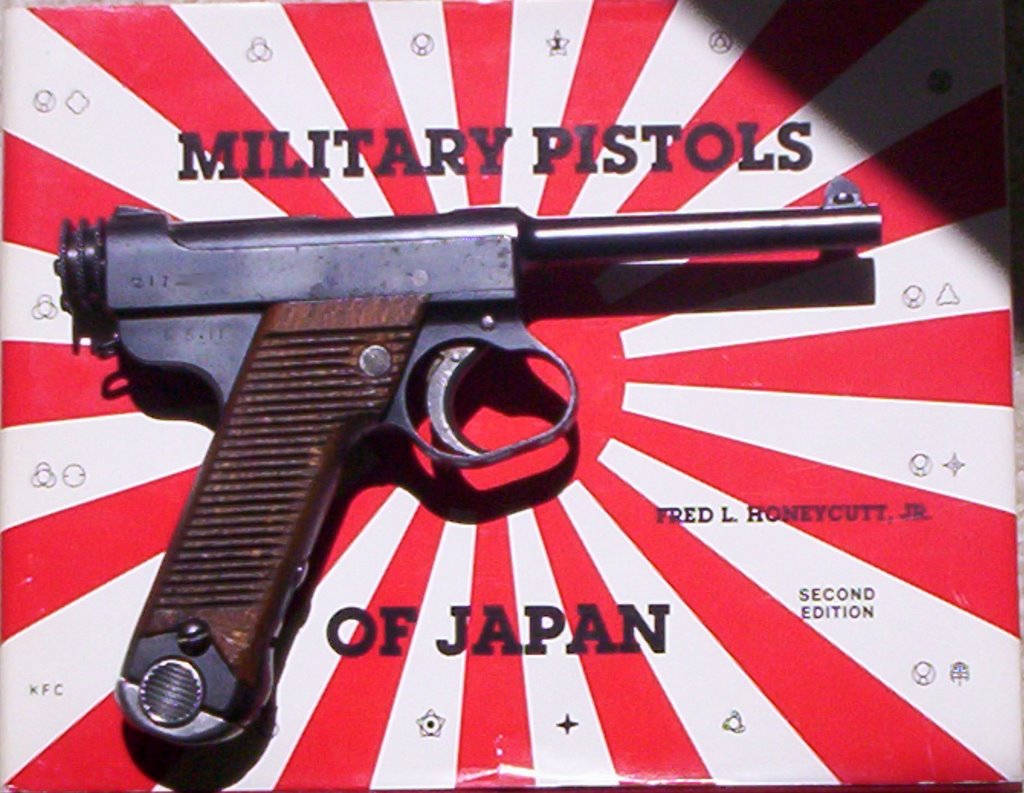
My Nambu Type 14 and the standard reference work on these guns

The Type 14 looks a lot like its grandpa and papa, with significant internal differences including doing away with a grip safety. Its slab-sided grips are unlovely, but “pretty” was not part of its design. Still, Type 14s are interesting handguns to handle, take apart, and shoot.

They handle much like a Luger because of its similar grip angle. When you disassemble a Type 14, the trigger guard is the key. It slides down and off when you have the magazine catch in the right position. Once taken apart, you’ll find more springs than what seems necessary.

I’ve shot my Nambu, but not successfully. Despite having springs everywhere inside it, the firing pin spring was worn out and that led to too light primer strikes. I'll buy a new one soon. However, the few shots I got off though were very accurate.

Nambus are accurate partly due to balance and pointability. The sights just naturally fall on target. A Nambu’s sights are like few others. The front sight is a pyramid and the rear notch is an inverted pyramid. They work together quite nicely.

Nambus were not known for reliability. In fact, there was a major recall in the 1930s due to firing pin breakage. Later Nambus had a large trigger guard, but early Type 14s had a small trigger guard. That was fine on a range, but soldiers couldn’t get their trigger fingers into the guard when they were wearing gloves (Manchuria is cold in the winter). Its cartridge, 8mm Nambu, is also notoriously under powered.

My Nambu was made in November 1930 at the Koishikawa Arsenal. Koishikawa was a government operated factory, but many Type 14s were made by private companies, even The Tokyo Gas and Electric Company. My Nambu was originally equipped with a small trigger guard, but many officers paid to have the arsenal install a large trigger guard. When the arsenal did so, it numbered all the newly installed parts so that they matched the gun.

My Type 14 has all matching parts (except the magazine) and is in decent condition (after I eradicated a layer of old cosmoline and gunk). It’s a welcome addition to my World War II firearms collection.

Wednesday, May 10, 2006

One From the Vault

Steyr-Hahn Model 1912
Once upon a time, there was a land named the Austro-Hungarian Empire. And that empire extended over much of Central Europe and most of the Balkans. Her ruler was noted for his fear of change. So much so, that he refused to read documents that were typed on new-fangled typewriters. His name was Emperor Franz-Josef II. His heir, Arch-Duke Franz Ferdinand, managed to get himself killed by an anarchist in a little town called Sarajevo.

Because of various strange and entangling alliances, this murder led to the beginning of World War I. The Austro-Hungarian Empire found itself allied with the Ottoman Empire and the German Empire against France, Great Britain, Russia, and eventually the United States. The war swept away old empires including that of Franz Josef’s. The rest is history.

Steyr built most of Franz-Josef’s arms, but its real name was Oesterreichische Waffenfabricks Gesellschaft and was located in Steyr, Austria. Army officers needed a reliable and modern semi-auto pistol at their side when they marched off to war. They got reliable, but they didn’t get modern.

A Steyer-Hahn’s least modern feature is how you load it. It doesn’t have an external magazine. Instead, you pull back the slide until it locks and then use a stripper clip to push rounds into an internal magazine. Such a feature is a surprising throwback for a semi-auto pistol designed around 1910. After all, Lugers, Colts, and other pistols all had external magazines that helped make reloading faster.
Steyr-Hahn Complete with Stripper Clip

Steyr came up with the Steyr-Hahn pistol based on a couple of their earlier models. Externally, it bears a strong resemblance to a Colt Model 1905 military pistol (you’ll need use the link’s “Quick Search” feature). There was a lot of cross pollination among gun makers of the time, so it’s not impossible that a few ideas went back and forth, but I can’t prove that one way or the other.

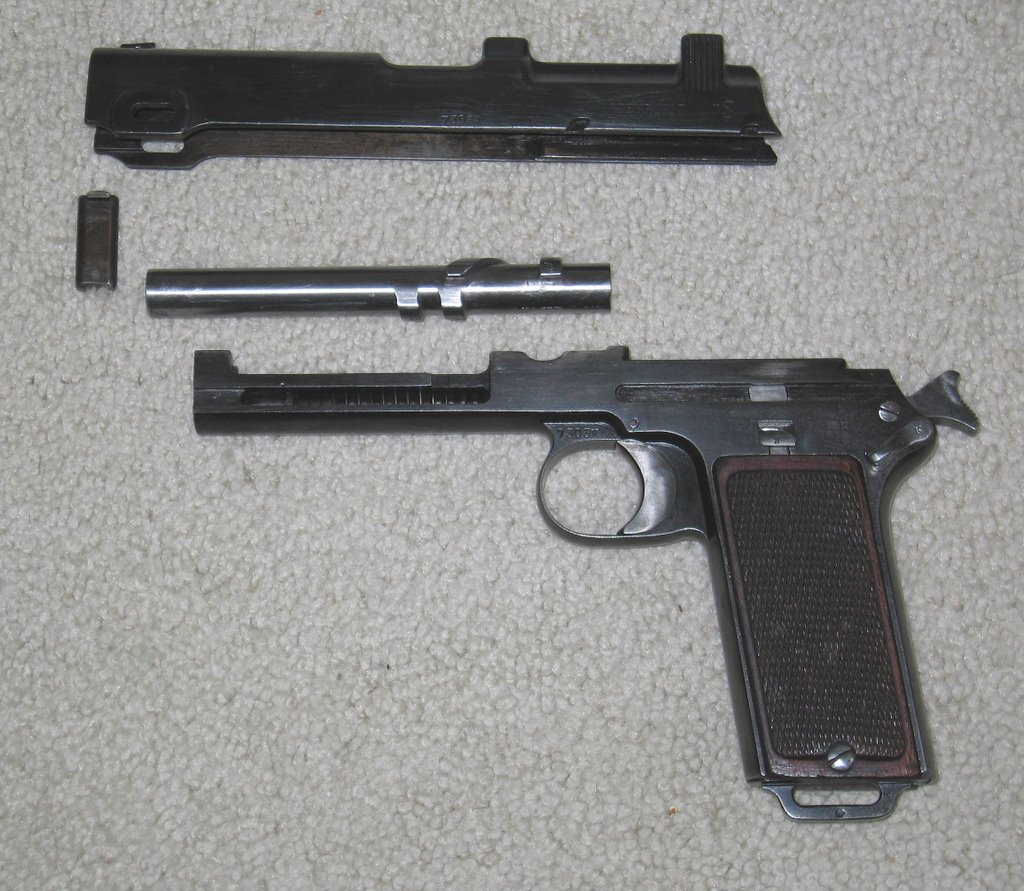
Still, the Steyr-Hahn has several features that aren’t found on any Colt. The internal action works through a cammed barrel as you can see. After firing, the recoil drives the slide and barrel back. Cams rotate the barrel about a half turn lining up magazine and feeding lip. It works well and is both an interesting mechanism and an example of precision machining.
Steyr-Hahn Design

The Steyr is slab-sided, heavy, and well engineered. In fact, Steyr-Hahns earned their reputation for reliability because it’s almost over engineered. It has a few curious features like a rear sight that sits on a pedestal that’s also a cocking handle and then there’s the bridge for the stripper clip.

The gun takes a now hard-to-find cartridge—9mm Steyr. It was a hot load for the time with a muzzle velocity of 1115 feet per second. Its 115-grain bullet was usually jacketed in steel. Make no mistake, it packed a punch, at least for a Euro-pellet.

Other armies used Steyr-Hahns as well. Chile and Romania adopted it as their service weapon. In fact, most Steyr-Hahn’s I’ve seen are marked “Ejercito de Chile,” Army of Chile. After World War I, many Austrian Steyrs ended up being converted to 9mm Luger and then hung on gun belts of Austrian and Bavarian police officers.

My gun was made in 1917 and was accepted into Austrian service the same year. My Steyr-Hahn is in great condition although someone got a little too enthusiastic with the cold blue for my taste. It’s a Model 1912—there was an experimental 1910 model and a Model 1911.

I had no trepidation when I fired it, because it’s so well built. There is very little felt recoil thanks to its rather noticeable weight. The trigger is heavy, but it's accurate partly because its sights are easy to pick up. Field stripping is a piece of cake. You pull out the front wedge, manipulate the slide just so and suddenly you’re holding a slide, a barrel and a frame.

So that’s a Steyr-Hahn. It’s a stand-in for an empire that is no more and, just like that empire’s leader, it refused to change with the times when its designers stood by their stripper clips.

Saturday, April 15, 2006

BAG (Buy a Gun) Day 2006

Today is BAG Day and it’s time to share my purchases with my small corner of the blogosphere. It was only a month ago that I was crying about not knowing what I would get for BAG (Buy a Gun Day). Then I mentioned that I had focused my thoughts on two guns, a coach gun and Walther P-22. Finally, I reported on buying a coach gun and the very next weekend I found a gun in a gun show that had to go home with me, a Japanese Nambu.

First though a word about BAG Day. Aaron of Aarons.cc started it, but his site was hacked recently and is thoroughly down, so no linky. It’s a simple idea. Every April 15 our government demands that we pay our taxes or go to jail. Many of us pay too much in withholding taxes and get a refund that represents only a fraction of what we paid that year. Buying guns is a way of putting that refund to good use while maintaining an armed citizenry. Even if you don’t get a refund, the latter is not a bad reason to buy a gun.

I collect guns and don’t need a reason to buy one, but I also believe that the best way to protect our firearm rights is for a non-gunnie to buy a gun. That doesn’t mean a new gun owner becomes a “gunnie” immediately, but now he or she has a stake in gun ownership. His or her gun represents one more gun that gun banners would have to steal if they ever get their way. I use BAG Day not to acquire a new gun, but to express my passion for owning guns and my desire for a non-gunnie to join in.

Without any further ado here is my first BAG Day gun for 2006. I actually bought it on April 1, but I used my tax refund, so it counts for BAG Day.
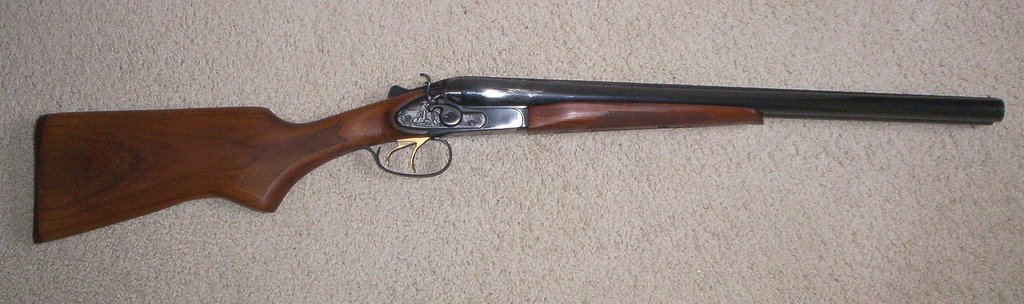
A Gently Used Coach Gun

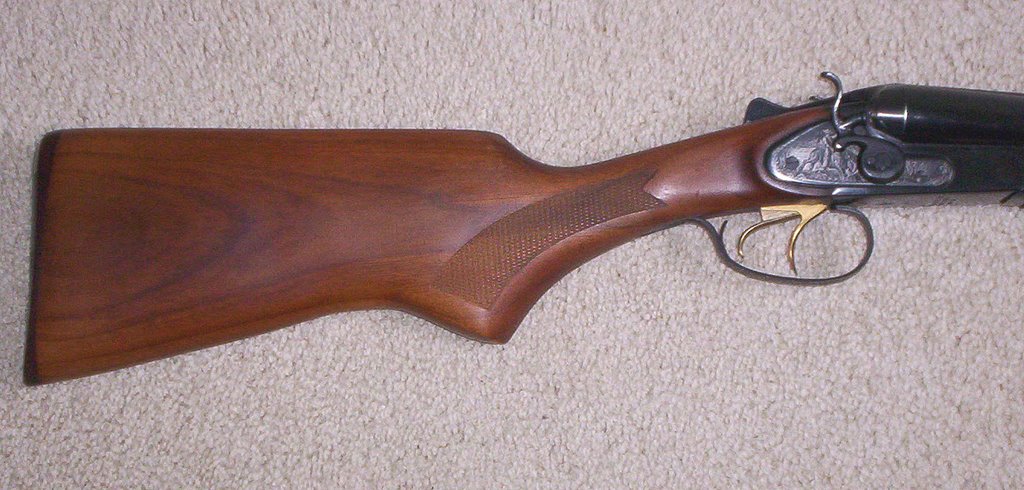
It is a Baikal Bounty Hunter II. I love the color of the stock and the way it contrasts with the lockwork and the butt plate.
A fine example of Russian workmanship

It was used. Baikal is no longer sold here under that name. Remington imports them under the Spartan brand. One of these days, I’ll use it when I give Cowboy Action Shooting a whirl.

I ended up with a second BAG Day purchase. This Nambu spoke to me at a gun show and I answered its call.
Nambu Type 14 Pistol

It is a great addition to my World War II gun collection. I will cover it in a “One From the Vault” soon.

So that’s it for my BAG Day 2006.

Wednesday, March 08, 2006

One From the Vault

Baikal IZH-35M
What’s the nicest thing one could say about this ugly duckling of a gun? How about that it shoots extremely accurately and reliably?
Bill's Target Pistol

Yosemite Sam’s (Bill’s) uses a Baikal IZH-35M as his bullseye pistol. It’s a semi-automatic target pistol chambered in .22 long rifle made in Russia and was once imported by European American Armory (EAA).

It’s an interesting hunk of metal when you start looking at it. The slide sits under the barrel. What appears to be a slide is really an immobile upper cowling. Instead, you push back two tabs near the gun's muzzle and thus shove the internal bolt back. Its hammer is exposed, sort of. It sits on top of the gun when it’s cocked. When you pull the trigger, the hammer drops like a trapdoor. A red dot on the hammer’s top serves as a loaded gun indicator. The slide doesn’t lock back when you fire the last round, so it helps to count to five as you shoot it.

I mean five because that’s its magazine capacity. After all, it’s designed for bullseye shooting. The gun comes with two very over-engineered magazines. There’s a lot of steel in these puppies, so much so I’d swear they could hold up a tractor.

An IZH-35M doesn’t have a pretty finish. It almost looks like factory workers polished the steel with a hammer before bluing it. In fact, bluing is a misnomer. It’s more of a dark-grayish brown color. The ergonomic grips are smooth and utilitarian, but also not pretty. But, how a gun shoots is the main thing.

Bill has put about 3,000 rounds through his gun. He hasn’t had a misfire, failure to feed, or failure to eject. However, he did have a problem with the grip safety. If he didn’t hold the gun just right, he couldn’t engage a very minimalist grip safety and the gun wouldn’t fire. We solved that problem with a piece of duct tape to hold it closed. A gunsmith friend said that Baikal added a grip safety to satisfy complicated Federal import guidelines. Whatever the reason, it’s very much an afterthought. Import though has only happened since the fall of the Soviet Union.

Baikal pistols were rarely seen in America while the Soviet Union existed. You did see them during competitions with the Soviet Olympic Team. Bill’s IZH-35M is basically the same gun as they used with some changes as the model improved.

Partly because of its pedigree as a professional shooter’s tool, the gun is very user friendly. Bill can adjust the trigger in several different ways. One screw changes the trigger’s position relative to the grip, another screw changes its pull weight, and another adjusts its take up. Surprisingly for a target pistol, it has a two-stage military-style trigger. One must take up the slack before the real trigger pull begins.

As you might expect, it’s a very accurate pistol. Its rear sight is completely adjustable and nicely frames its front sight. The barrel is attached to the frame. The gun is heavy enough that you scarcely feel recoil and it returns to its point of aim very quickly. The grips help ensure proper placement of Bill’s hand and trigger finger. If you’re a southpaw, you're out of luck. Baikal doesn’t make a left-hand model and there’s no practical way to shoot the gun left-handed.

IZH-35Ms impressed another gun maker, Walther. They bought many from Baikal and refinished them, added new grips, crafted a slide stop, and called them Walther KSP200. They even made a left-handed version.

Baikal is a trade name for Izhevsky Mekhanichesky Zavod, a company formed in 1807 to make ammunition. It branched out to guns and armed Czars and Commissars. After the fall of communism, the factory became self-supporting and is profitable. EAA used to import Baikals and may still have a handful for sale. Remington bought Baikal’s shotgun line for importation, but to the best of my knowledge they didn’t pick up Baikal’s pistol line. Remington sells the shotguns under its Spartan trademark.

Oh, one other Baikal IZH-35M feature: they retail cheaply. Bill bought his gun brand new for under $450.00. Not bad for an accurate, reliable ugly duckling target pistol.

Wednesday, March 01, 2006

Why I Collect Guns

Hell in a Handbasket has a great post on collecting and shooting old guns. He mentions his Krag rifle has finger impressions probably left by a scared soldier fighting in the Spanish-American War. Now that’s a connection to the past. His post inspired me to try to put into words why I love to collect guns.

Ages ago in blog-time, I talked about collecting guns. I mentioned collecting. I talked about our criteria, the fact that I have a Curio & Relics license, and that I once worked in a museum and have taken apart, cleaned, conserved, and reassembled many guns. But, I didn’t talk about my passion that lies behind collecting guns.

First and foremost I love shooting. I’ve been doing it almost my entire life. I regularly shoot rifles, handguns, and shotguns. I’ve rented and shot submachine guns. I’d love to shoot a crew-served heavy machine gun and one of these days I will.

I love how guns are put together. I never get tired of taking a gun apart and seeing how a gun maker decided to make this particular design work. He labored in a field constrained with patents belonging to other people, material science, physics, ballistics, and a whole lot more. Each gun maker solved certain problems to ensure his gun design worked. One maker, like Luger, decided that a toggled slide would work best in a semi-auto while another, like Browning, decided that a reciprocal slide would work best.

Because of these constraints, guns come in an almost infinite variety while still maintaining their form and function. Most handguns, for instance, have a grip, a barrel, and a trigger. Within those parameters you will find revolvers, semi-autos in a bewildering variety, pen guns that don’t even have a grip, derringers and so many more.
How's this for variety? A 19th Century "Palm Squeezer."

The same thing's true with rifles and shotguns, though with less outward variety. A long gun must fit the human shoulder, arm reach, and hands while a handgun must fit only the hand. That’s not to denigrate the variety of long guns. They have straight English stocks, semi-pistol grip, pistol grips, fore ends that go all the way to the muzzle, splinter fore ends that are barely there, and more action types than you have time to read about.

In this post, I’ve mentioned shooting, fascinating mechanisms, and variety, but there’s another reason why I love to collect guns. It’s what Hell in a Handbasket covered so well--that connection with the past. For example, I recently bought a Steyr-Hahn. I shelled out my hard-earned money for something I’ll never use as a self-defense weapon. I certainly won’t target shoot with it and I’ll probably shoot one box of ammo out of it while I own it. It’ll spend more time in the safe than it ever will in my hand.

But I bought it because it connects me to history. It was once the sidearm of the Austro-Hungarian Empire, which ruled my ancestors. It was put into service in 1917, during World War I, the War to End All Wars, only it didn’t. I don’t know who used it, if he ever shot it in anger or fear, but it’s a palpable connection with my past and with human history. I pick it up, or one of my Lugers, or my M1 Garand, or Bill’s Enfield and I can better understand history. Hefting them, loading them, shooting then, and feeling their recoil helps me understand what our ancestors experienced.

I studied history in college and graduate school and I make my living now helping to preserve today’s history for future generations. Thus, it’s no surprise that I feel such a connection. A handful of my colleagues don’t want to understand it. One of them once said that he wouldn’t even touch a gun because “they’re made to kill.” I point out to these naysayers that mankind rose from the swamps only because of our ability to make weapons and other tools. They can’t understand that a weapon is just another tool.

My love of guns is a connection with the past. I plan to ensure that my collection is available for future generations and that those generations are able to shoot and collect guns. They too can touch a part of that which makes us human.

Sunday, February 19, 2006

One From the Vault

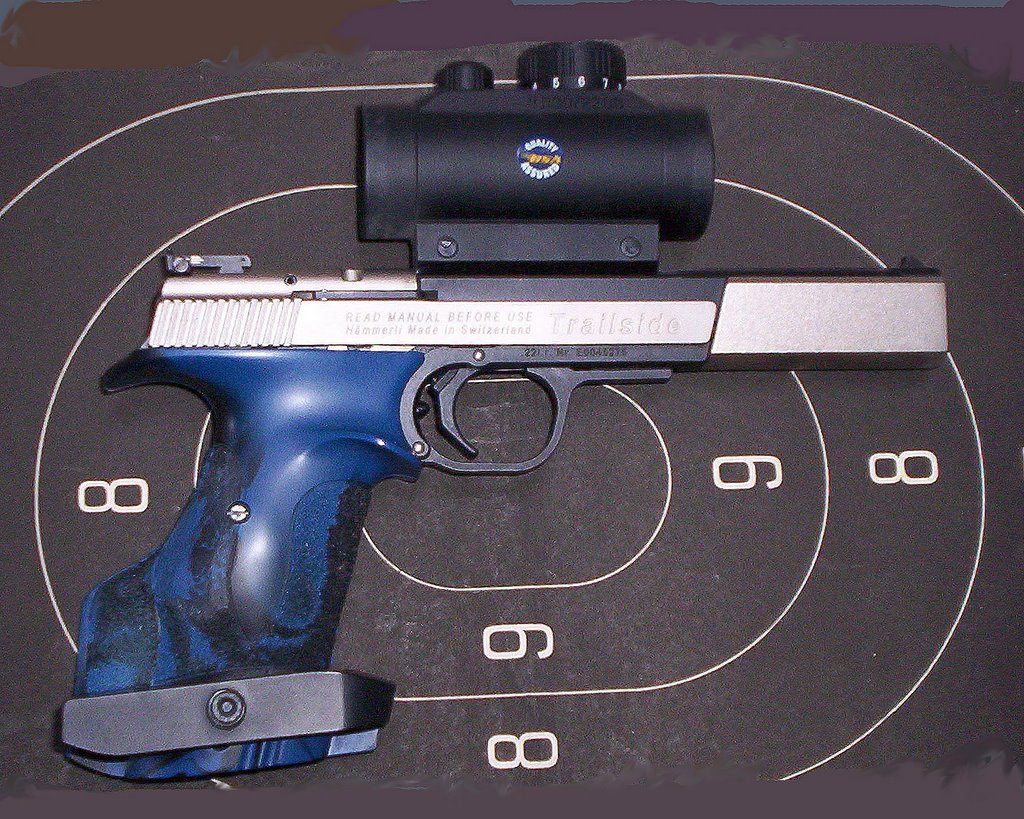
Sig/Hammerli Trailside (Xesse)
Most of Ten Ring’s “One From the Vault” posts reflect my collecting interests, mouse guns and military guns. Frequent commenter, Seth from Massachusetts, asked me to feature my bullseye pistol because of my frequent mention of a bullseye league Bill and I shoot in (here's a sample). Seth wanted to know more about the gun I use (we’ll discuss Bill’s gun in another “One From the Vault”).

So, without spilling any more bits, here is my Sig/Hammerli Trailside pistol:
Sig Trailside (Note: we do not use backdrop target in our league)

And the other side:

Sig makes a family of Trailside pistols including plinkers, target pistols, and the Xesse competition model. All are .22s. Sig went to Hammerli, one of their subsidiaries, and asked them to design an accurate pistol that costs hundreds of dollars rather than one in Hammerli’s usual $1,500 to $2,000 range. They came up with the Trailside. It’s a straight blowback with a fixed barrel. Target models sport sights capable of fine adjustments.

As you see by the picture, I stopped using these fine iron sights although I have no quarrel with their design. I blame my aging eyes, which do better with a red-dot sight. I was reluctant to do so because I like the old ways in gun design and shooting, but one must change with the times. Because I wasn’t sure how I’d like a red-dot I bought a cheap BSA sight. I must admit it improved my scores and made shooting much easier. I'll probably buy a better quality red-dot sight before next year’s bullseye season.

My Trailside is an Xesse model with ergonomic grips. Out of the box, the grip was too large for my hand so I had to take a Dremel tool to the right grip. It comes with a weight at the end of the barrel to reduce recoil and keep you on target. One can buy various accessories such as lighter weights, dry fire plugs, and magazines. The latter two deserve separate paragraphs.

The Trailside’s manual states it’s not safe to dry fire it without a plug. The dry fire plugs are made of soft plastic that covers the chamber mouth and protects it. To me, it’s surprising that a modern .22 pistol can’t be dry fired (that is aimed, and "shot" without a cartridge) because dry firing is a great practice regimen. Older .22s were made without a stop on the firing pin thus allowing a dry fired pin to peen the chamber mouth. Over time, a firing pin strike could fail to compress the cartridge correctly and not ignite its priming compound.

A Trailside magazine is made of high-impact plastic—no metal in one except for a spring. The magazine that came with the gun had a problem that led to occasional failure to feed, but Sig, through my gun dealer, replaced it. That’s the only problem I’ve had with the gun. After several thousand rounds it’s proved very reliable.

A dedicated bullseye gun must be accurate. Trailside is a tack-driver partly due to its fixed barrel and a fairly light trigger weight of 3.5 pounds. Its pull has no stacking with a crisp let-off. Because the competition model is heavy there’s little felt recoil and I’m able to get back onto target rapidly.

I bought my Trailside for under $550.00. Remember this is for a gun made by a quality maker and designed by a firm that specializes in target pistols. There are a couple of drawbacks. The magazines are expensive (about $45.00) and being plastic they could break if dropped onto the lips. Disassembly is easy, but not with a red-dot sight installed. The sight prevents me from removing the slide. A Bore Snake makes the chore possible without removing the slide completely. Even with these drawbacks, it’s been a great gun for me to own.

There’s a rumor that Sig will no longer be making the Trailside partly because they have a new plinker in the Sig Mosquito and perhaps because of a large government contract for law enforcement pistols. I don’t know if the rumor’s true, but the Sig website’s Trailside page has an ominous note: “Available Models: Updated product information coming soon.” Better buy ‘em while you can.