Yosemite Sam and I took a vacation back in May of this year. On the way back home from the NRA Convention in sunny Phoenix, we stopped at the Whittington Center. We poked around a bit in the gift shop where I found an autographed copy of The Complete Book of the .22: The Guide to the World's Most Popular Guns (link below) by Wayne van Zwoll. With a title that long, it had to go home with me.
Due to the press of work, other books, fun, traveling, and stuff, I never got around to reading it until recently. As is my usual pattern, I'm posting a review here of books my fellow gun nuts may want to read.
Van Zwoll's name shouldn't be new to most of you. He's written many articles, a number of books, and appeared in cable TV shows. He's shooter and a scholar having recently received a doctorate.
His Complete Book pretty much lives up to its name. Van Zwoll first walks us through memory lane recounting his adventures with .22s while growing up. He tells about woodchuck shooting and even tosses in a few recipes--Pasture Poodle Stew might just hit the spot.
He then turns his spotlight on rimfire guns and includes the .17 HMR. I guess his book should be renamed and include .17 in the title. His next section is about the history of various gun makers and the .22s they produced. I got to admit that I've read a lot about gun makers and there was little new in these synopses. It was slow going for me here, but the brief histories are useful to someone who hasn't read much about these companies and their products.
The most important section is about shooting the .22. Van Zwoll doesn't include much discussion of handguns. He's a rifleman while I'm more of a pistolera. But, each to their own. The book has some very good pointers on marksmanship, ballistics, zeroing, and mindset.
The Complete of the .22 is a good entree into the world of the .22. It's not the final word on .22s and for that matter isn't really complete when the subject is that big. American's shoot more .22 caliber than any other round and logically own more .22 guns than any other. That's a mighty big topic. Still, van Zwoll does credit to his subject. It definitely found a place in my firearms library.

Showing posts with label Books. Show all posts
Showing posts with label Books. Show all posts
Friday, November 13, 2009

Friday, August 14, 2009
Rollicking Fun: Monster Hunter International
You know you’re really gonna like a book when it begins, “On one otherwise normal Tuesday evening I had the chance to live the American dream. I was able to throw my incompetent jackass of a boss from a fourteenth story window.”
Larry Correia’s Monster Hunter International (link below) is fun from cover to cover. Its hero is Owen Z. Pitt. His father named Owen after a POS Australian sub-machine gun he had carried in the Vietnam War. That naming becomes significant later, but no more on that. I’m shooting for a spoiler-free review.
Shooting is a good metaphor. There’re a lot of guns in Monster Hunter International. Pitt is a self-described gun nut (just like me). He collects guns and has been shooting them since he was a child (just like me). Unlike me, he is about 6’4” and a former extreme fighter now turned accountant.
His boss is beyond incompetent. One day, his boss calls Pitt into his office. He transforms into a werewolf in front of Pitt’s disbelieving eyes and then it’s off to the races.
With the help of brawn and a concealed .357 revolver (not all that useful on a werewolf, but every little bit helps) Pitt defenestrates his furry boss. He wakes in the hospital. Government goons are stationed there to ensure that he doesn’t turn into a werewolf. If he does, Pitt gets a silver bullet to the brain pan. While there, Pitt learns that werewolves, vampires, and things that go bump in the night are real.
Not only are they real, but government agents fight them. Private outfits, one of which is named Monster Hunter International, receive bounties for each creepy-crawly they kill. That outfit recruits our erstwhile accountant and gives him his bounty check from Uncle Sam, $50,000. Not bad work; he gets to kill his boss in self-defense and gets good coin to boot. Lucky SOB.
The book explores the training a good monster hunter gets, follows Pitt and his fellow newbies through various battles, until Pitt and company find out they’re dealing with a supreme monster who could bring back Lovecraftian Old Ones. Does it get any better than that?
I’m dangerously close to spoilers here, so I’ll close with a few observations. Correia is a firearms instructor and a gunnie. Sentences close to a gun enthusiast’s heart are sprinkled liberally throughout the book. For example a vampire smashes Pitt’s favorite shotgun, a well-used 870 Remington, and his Kimber pistol. I shed a tear.
Like me, Correia and his characters prefer the 1911 platform. Don’t get me wrong, Glocks are good guns, but I happen to like John Moses Browning’s contraption better. Here is what a leading female character said, “[My little brother’s] a Glock nut. The poor deluded bastard.” I’m in love, platonically of course.
On final thing about Monster Hunter International; I hope there’s a sequel.
Larry Correia’s Monster Hunter International (link below) is fun from cover to cover. Its hero is Owen Z. Pitt. His father named Owen after a POS Australian sub-machine gun he had carried in the Vietnam War. That naming becomes significant later, but no more on that. I’m shooting for a spoiler-free review.
Shooting is a good metaphor. There’re a lot of guns in Monster Hunter International. Pitt is a self-described gun nut (just like me). He collects guns and has been shooting them since he was a child (just like me). Unlike me, he is about 6’4” and a former extreme fighter now turned accountant.
His boss is beyond incompetent. One day, his boss calls Pitt into his office. He transforms into a werewolf in front of Pitt’s disbelieving eyes and then it’s off to the races.
With the help of brawn and a concealed .357 revolver (not all that useful on a werewolf, but every little bit helps) Pitt defenestrates his furry boss. He wakes in the hospital. Government goons are stationed there to ensure that he doesn’t turn into a werewolf. If he does, Pitt gets a silver bullet to the brain pan. While there, Pitt learns that werewolves, vampires, and things that go bump in the night are real.
Not only are they real, but government agents fight them. Private outfits, one of which is named Monster Hunter International, receive bounties for each creepy-crawly they kill. That outfit recruits our erstwhile accountant and gives him his bounty check from Uncle Sam, $50,000. Not bad work; he gets to kill his boss in self-defense and gets good coin to boot. Lucky SOB.
The book explores the training a good monster hunter gets, follows Pitt and his fellow newbies through various battles, until Pitt and company find out they’re dealing with a supreme monster who could bring back Lovecraftian Old Ones. Does it get any better than that?
I’m dangerously close to spoilers here, so I’ll close with a few observations. Correia is a firearms instructor and a gunnie. Sentences close to a gun enthusiast’s heart are sprinkled liberally throughout the book. For example a vampire smashes Pitt’s favorite shotgun, a well-used 870 Remington, and his Kimber pistol. I shed a tear.
Like me, Correia and his characters prefer the 1911 platform. Don’t get me wrong, Glocks are good guns, but I happen to like John Moses Browning’s contraption better. Here is what a leading female character said, “[My little brother’s] a Glock nut. The poor deluded bastard.” I’m in love, platonically of course.
On final thing about Monster Hunter International; I hope there’s a sequel.
Friday, June 26, 2009
A Dark Read, One Second After
I scared myself this week. No, I didn't have a negligent discharge, an almost car accident, a slip in the tub. I read a book.
I read it in about a day and a half. I couldn't put it down and I had the awful sense of passing a car wreck and not being able to tear my eyes away from a sheet-draped mound. The book is William Forstchen's One Second After (link below).
Forstchen's book is not a survivalist novel, but is about TEOTWAWKI (the end of the world as we know it). If you've seen his name before, it was probably because he is Newt Gingrich's writing partner for their series of history-based novels. His protagonist, like Forstchen, lives in a small town near Asheville, North Carolina and teaches history at Montreat College. Unlike, Forstchen, the protagonist is a former Army colonel although most of his career centered around teaching military history.
The words in the title refers to the change in America one second after we are hit with an Electromagnetic Pulse (EMP). Terrorists or another country, as is speculated by various characters, have hit us with three nuclear weapons burst twenty-five miles above the Earth and arrayed in such a way that the resulting EMPs destroy our civilization.
Electronic circuits are fried even if they were on a surge protector. No cars or trucks made after the early 1980s will run. Cell phones, computers, land-line phones, municipal power and water systems, ATMs, and everything else that we rely on so much are inoperable (with the exception of gravity-fed water systems).
Grocery stores stand empty in less than two days. Travelers are stranded on freeways, planes fall out of the sky, people with medical conditions are staring the Grim Reaper in the face. Hunting becomes a way of life even as game becomes depleted. Ammo is a medium of exchange.
Even our military is not spared. Some equipment that was thought to be hardened against EMP burns out. Command and control communications are disrupted.
The book goes on in this vein and is all too plausible. Communities come together while others fall apart. Some people prey on others (literally). Food is the biggest problem. Basically, as indicated in the book's afterword, America has returned to the nineteenth century without having a nineteenth century knowledge base. We know how to program a cell phone, but we don't know how to hitch a mule to a plow.
One Second After is a dark and scary read. Forstchen gives his characters some hope, some victories, but all of them are lost in a world that is no longer theirs. All too plausible.
Newt Gingrich wrote a foreword and Captain Bill Sander (USN) wrote an afterword. Both state that One Second After is based on unclassified reports. An EMP strike is a real threat and could be a true TEOTWAWKI unlike other survivalist scenarios. In fact, it could inspire readers to improve their own knowledge base and better prepare for such a terrible event (Foxfire books anyone).
I read it in about a day and a half. I couldn't put it down and I had the awful sense of passing a car wreck and not being able to tear my eyes away from a sheet-draped mound. The book is William Forstchen's One Second After (link below).
Forstchen's book is not a survivalist novel, but is about TEOTWAWKI (the end of the world as we know it). If you've seen his name before, it was probably because he is Newt Gingrich's writing partner for their series of history-based novels. His protagonist, like Forstchen, lives in a small town near Asheville, North Carolina and teaches history at Montreat College. Unlike, Forstchen, the protagonist is a former Army colonel although most of his career centered around teaching military history.
The words in the title refers to the change in America one second after we are hit with an Electromagnetic Pulse (EMP). Terrorists or another country, as is speculated by various characters, have hit us with three nuclear weapons burst twenty-five miles above the Earth and arrayed in such a way that the resulting EMPs destroy our civilization.
Electronic circuits are fried even if they were on a surge protector. No cars or trucks made after the early 1980s will run. Cell phones, computers, land-line phones, municipal power and water systems, ATMs, and everything else that we rely on so much are inoperable (with the exception of gravity-fed water systems).
Grocery stores stand empty in less than two days. Travelers are stranded on freeways, planes fall out of the sky, people with medical conditions are staring the Grim Reaper in the face. Hunting becomes a way of life even as game becomes depleted. Ammo is a medium of exchange.
Even our military is not spared. Some equipment that was thought to be hardened against EMP burns out. Command and control communications are disrupted.
The book goes on in this vein and is all too plausible. Communities come together while others fall apart. Some people prey on others (literally). Food is the biggest problem. Basically, as indicated in the book's afterword, America has returned to the nineteenth century without having a nineteenth century knowledge base. We know how to program a cell phone, but we don't know how to hitch a mule to a plow.
One Second After is a dark and scary read. Forstchen gives his characters some hope, some victories, but all of them are lost in a world that is no longer theirs. All too plausible.
Newt Gingrich wrote a foreword and Captain Bill Sander (USN) wrote an afterword. Both state that One Second After is based on unclassified reports. An EMP strike is a real threat and could be a true TEOTWAWKI unlike other survivalist scenarios. In fact, it could inspire readers to improve their own knowledge base and better prepare for such a terrible event (Foxfire books anyone).
Friday, June 19, 2009
What I'm Reading Now: Liberal Fascism
Jonah Goldberg's Liberal Fascism (link below) came out in January 2008. It was just released in paperback on June 2. I'm cheap and waited for the price to drop and it was a long wait. Many of you have already read it, so this is for those cheap people like me who waited for the right price point (by the way, what is this thing called libraries?).
I'll preface this brief review with a note. My graduate degree is in history with a concentration in German diplomatic and intellectual history. I know more than a little about the history quoted in Liberal Fascism.
For the most part, Goldberg is pretty close to right, although he selects points that support his thesis leaving other points unanswered. For instance, when he deals with racialist views. He rightly condemns leftists that held these views, but ignores how acceptable these views were in the spirit of the times. Many conservatives would have held the same views.
Goldberg didn't mean for Liberal Fascism to be a history treatise. Instead, he wrote a polemic and as such his book is very effective. His clear writing makes you wonder about so much we've been taught about the truth behind socialism and fascism. It makes you wonder how much our father's and grandfather's generations were imbued with a semi-fascist philosophy that is now coming to a head in this generation.
As Goldberg points out, fascism takes many forms depending on where it's found. Italian and German fascism were different, so it stands that an American fascism would be more different still. Good point. However, I think that applying fascism to the far and not-so-far left is no more useful than when the left calls conservatives fascist. (There is that little shiver of delight to throw the label back at them though.)
I think the term "statist" is much more useful than fascism in describing the left. Bear in mind that Communism, fascism, socialism are all statist. All of them hope to use the state to improve mankind's lot. However, where that improvement takes mankind differs very much depending on the "ism" in question.
Using the state to improve society is fraught with dangers that cannot be ignored. Left-wing people think that if they just create one more welfare program, re-distribute wealth just a little more, adopt identity politics more strongly then we can create social justice. We can abolish poverty, crime, war, and every other bad thing. Of course, they define what is bad (e.g., self-defense because it hurts or kills another person, even if that person was the attacker).
The left resents the right for trying to stop them from using the state to improve society. They call conservatives selfish, unjust, unfair, and worse. They believe that the right is simply trying to protect their prerogatives to further "oppress" the people. They want a collective effort and individuals stand in their way. As that thought takes them further down the statist road, they soon look to using the state to force compliance with their dreams.
That way lies the madness of the guillotine and must be stopped. Society is not perfectible and we must respect the individual as a unique human being and not for his/her role as a member of the collective. That's why this book is so important to read.
I'll preface this brief review with a note. My graduate degree is in history with a concentration in German diplomatic and intellectual history. I know more than a little about the history quoted in Liberal Fascism.
For the most part, Goldberg is pretty close to right, although he selects points that support his thesis leaving other points unanswered. For instance, when he deals with racialist views. He rightly condemns leftists that held these views, but ignores how acceptable these views were in the spirit of the times. Many conservatives would have held the same views.
Goldberg didn't mean for Liberal Fascism to be a history treatise. Instead, he wrote a polemic and as such his book is very effective. His clear writing makes you wonder about so much we've been taught about the truth behind socialism and fascism. It makes you wonder how much our father's and grandfather's generations were imbued with a semi-fascist philosophy that is now coming to a head in this generation.
As Goldberg points out, fascism takes many forms depending on where it's found. Italian and German fascism were different, so it stands that an American fascism would be more different still. Good point. However, I think that applying fascism to the far and not-so-far left is no more useful than when the left calls conservatives fascist. (There is that little shiver of delight to throw the label back at them though.)
I think the term "statist" is much more useful than fascism in describing the left. Bear in mind that Communism, fascism, socialism are all statist. All of them hope to use the state to improve mankind's lot. However, where that improvement takes mankind differs very much depending on the "ism" in question.
Using the state to improve society is fraught with dangers that cannot be ignored. Left-wing people think that if they just create one more welfare program, re-distribute wealth just a little more, adopt identity politics more strongly then we can create social justice. We can abolish poverty, crime, war, and every other bad thing. Of course, they define what is bad (e.g., self-defense because it hurts or kills another person, even if that person was the attacker).
The left resents the right for trying to stop them from using the state to improve society. They call conservatives selfish, unjust, unfair, and worse. They believe that the right is simply trying to protect their prerogatives to further "oppress" the people. They want a collective effort and individuals stand in their way. As that thought takes them further down the statist road, they soon look to using the state to force compliance with their dreams.
That way lies the madness of the guillotine and must be stopped. Society is not perfectible and we must respect the individual as a unique human being and not for his/her role as a member of the collective. That's why this book is so important to read.
Wednesday, April 08, 2009
Emergency: A Gunnie Book Review
I first heard about this book at Michael Bane’s site. Bane’s review got me interested enough to buy and read it. Meanwhile, Smallest Minority reviewed it and mentioned it, so this is a double, maybe even triple, “me too” post.
Emergency: This Book Will Save Your Life, by Neil Strauss is not a survival manual. It has a few pointers in a continuing comic strip that includes some useful ideas; how to cut flexi-cuffs with paracord (only if whomever cuffed you is dumb enough to restrain hands in front), how to turn a credit card into a knife, how to make a ghillie suit, etc. Beyond these rudimentary points there is little that will actually save your life.
Instead, Emergency is about a liberal writer’s voyage into self-reliance. Strauss grew up in Chicago where if you needed to fix something you called the building super, if you needed to defend yourself you called a cop. After 9/11 and Katrina he began to fear dying in a disaster. As a lefty, he feared that “Bushco” could somehow force into cattle cars and blamed Bush for a slow Katrina response. He wanted to do something that could help him avoid such a fate.
He looked for a way to get a second citizenship (and eventually succeeded) in case he needed to bolt the country. He realized that if he needed to do so, he would have to survive until he could make it to his second country. He began collecting information and attending classes.
Along the way, he learned that not everything was as it seemed. He learned in Los Angeles’s CERT training that government would take three or more days to really help people. So much for Bush and Katrina.
He decided he needed to learn how to shoot and went to Guncite for training. He wanted to learn how to live off the land and went to Tom Brown Jr.’s tracking school. He realized he might need to provide medical assistance to himself or others and became an Emergency Medical Technician. He learned knife skills and how to slaughter a goat.
Along the way, he found out that to become self-reliant he had to rely on many people who had the skills to teach him. He also became a better citizen. He became someone who could and did stop at an accident scene and give aid.
He never gave up on his politics and I no longer agree with those politics. Yes, I gave him a couple or few dollars when I bought his book, but he has lessons to teach.
Chief among these lessons is that you must learn to survive from other people. Books can only take you so far. As Tom Brown said (quoted on p.253), “You can walk into any store and there are buy five survival manuals you can buy that will kill you.”
It behooves anyone who is interested in learning what it takes to become a small-s survivalist to read this book. It outlines a journey that many of us could take if we had the time and money.
Emergency: This Book Will Save Your Life, by Neil Strauss is not a survival manual. It has a few pointers in a continuing comic strip that includes some useful ideas; how to cut flexi-cuffs with paracord (only if whomever cuffed you is dumb enough to restrain hands in front), how to turn a credit card into a knife, how to make a ghillie suit, etc. Beyond these rudimentary points there is little that will actually save your life.
Instead, Emergency is about a liberal writer’s voyage into self-reliance. Strauss grew up in Chicago where if you needed to fix something you called the building super, if you needed to defend yourself you called a cop. After 9/11 and Katrina he began to fear dying in a disaster. As a lefty, he feared that “Bushco” could somehow force into cattle cars and blamed Bush for a slow Katrina response. He wanted to do something that could help him avoid such a fate.
He looked for a way to get a second citizenship (and eventually succeeded) in case he needed to bolt the country. He realized that if he needed to do so, he would have to survive until he could make it to his second country. He began collecting information and attending classes.
Along the way, he learned that not everything was as it seemed. He learned in Los Angeles’s CERT training that government would take three or more days to really help people. So much for Bush and Katrina.
He decided he needed to learn how to shoot and went to Guncite for training. He wanted to learn how to live off the land and went to Tom Brown Jr.’s tracking school. He realized he might need to provide medical assistance to himself or others and became an Emergency Medical Technician. He learned knife skills and how to slaughter a goat.
Along the way, he found out that to become self-reliant he had to rely on many people who had the skills to teach him. He also became a better citizen. He became someone who could and did stop at an accident scene and give aid.
He never gave up on his politics and I no longer agree with those politics. Yes, I gave him a couple or few dollars when I bought his book, but he has lessons to teach.
Chief among these lessons is that you must learn to survive from other people. Books can only take you so far. As Tom Brown said (quoted on p.253), “You can walk into any store and there are buy five survival manuals you can buy that will kill you.”
It behooves anyone who is interested in learning what it takes to become a small-s survivalist to read this book. It outlines a journey that many of us could take if we had the time and money.
Wednesday, January 28, 2009
Ted, White, and Blue: A Gunnie Book Review
Ted Nugent has done it again. He’s written another book with a subtitle of “The Nugent Manifesto.” If you don’t know Ted Nugent, where’ve you been living for the last thirty-some years? He’s a rock star best know for “Cat Scratch Fever,” a bowhunter with several TV shows in his quiver (couldn’t resist), and a gun advocate sitting on the NRA’s Board of Directors.
He’s not for everyone. He has an over the top writing and speaking style that is often blasted by liberals and gun banners. I’ve heard him talk at NRA conventions and don’t always agree with the way he puts things, but I can’t say he’s wrong either.
So, I gave Ted, White, and Blue a read. Surprisingly, he somewhat toned down his gonzo, balls to the wall style. Don't worry, he still speaks his mind and pulls no punches, but he wants people to read his book.
The book's been out a few months now. He wrote the book before the election and there are parts that are now a little dated (current events sure move fast). Still, there’s a lot in here that is not dependent on what’s in the news cycle right this minute.
He stays away, for the most part, from gun rights and covers topics that include health care policies, obesity, immigration, fighting terrorism, and other subjects.
He comes down on the side of personal responsibility, except he blames parents of obese children for turning their kids into, “pathetic fat zombies in front of the garbage videobox….” He believes that you need to step away from the doughnut, and that you should pay for your own health care. Fiscally, he wants Uncle Sam to go on a diet as well.
He says forthrightly that, “The people who enter America illegally have committed a crime. That makes them criminals…” He wants them treated as such and shown the door. He believes the War on Terror should be fought hard.
He discusses other hot button issues such as global warming, energy sources, and many more topics. He is advocating something quite radical and yet traditional at the same time. He wants government to leave us alone, he wants every one to succeed on their own merits, he wants secure borders.
On top of all this, he buys ammo by the pallet load. Take a second and re-read the last sentence—pallet load, I am so envious.
I’ve said many times that I want government to leave me alone. I don’t want a government that will take away guns, nor have one that will tell me to go to church. Nugent and I see eye to eye on those points and more. I don’t think I would ever call people “land whales” or say fat “…kids look like miniature versions of Michael Moore.” (Shudder). But that’s just me.
He’s not for everyone. He has an over the top writing and speaking style that is often blasted by liberals and gun banners. I’ve heard him talk at NRA conventions and don’t always agree with the way he puts things, but I can’t say he’s wrong either.
So, I gave Ted, White, and Blue a read. Surprisingly, he somewhat toned down his gonzo, balls to the wall style. Don't worry, he still speaks his mind and pulls no punches, but he wants people to read his book.
The book's been out a few months now. He wrote the book before the election and there are parts that are now a little dated (current events sure move fast). Still, there’s a lot in here that is not dependent on what’s in the news cycle right this minute.
He stays away, for the most part, from gun rights and covers topics that include health care policies, obesity, immigration, fighting terrorism, and other subjects.
He comes down on the side of personal responsibility, except he blames parents of obese children for turning their kids into, “pathetic fat zombies in front of the garbage videobox….” He believes that you need to step away from the doughnut, and that you should pay for your own health care. Fiscally, he wants Uncle Sam to go on a diet as well.
He says forthrightly that, “The people who enter America illegally have committed a crime. That makes them criminals…” He wants them treated as such and shown the door. He believes the War on Terror should be fought hard.
He discusses other hot button issues such as global warming, energy sources, and many more topics. He is advocating something quite radical and yet traditional at the same time. He wants government to leave us alone, he wants every one to succeed on their own merits, he wants secure borders.
On top of all this, he buys ammo by the pallet load. Take a second and re-read the last sentence—pallet load, I am so envious.
I’ve said many times that I want government to leave me alone. I don’t want a government that will take away guns, nor have one that will tell me to go to church. Nugent and I see eye to eye on those points and more. I don’t think I would ever call people “land whales” or say fat “…kids look like miniature versions of Michael Moore.” (Shudder). But that’s just me.
Wednesday, December 17, 2008
Is John Galt at Work
It's hard to believe it's been a week since I last posted and I was doing so good for awhile. Work has been picking up...yadda, yadda, yadda.
Here's something that struck me enough to grab the keyboard and bang away. Have you ever had an experience of reading a novel and thinking that the plot is unfolding in reality?
I've been reading Ayn Rand's Atlas Shrugged (link below, and since Rand was a capitalist, I get a small cut if you buy it using my link). Politically, I'm a small "l" libertarian who wants to be left alone, so I was aware of Rand's books, but never picked one up. Dr. Helen's blog post on going John Galt inspired me to buy a copy and I finally cracked it open last week.
If you've ever read the book you'll know that it's comprised of over 1100 pages of closely printed text. It has long paragraphs of densely reasoned ideology that Rand puts into the mouths of her characters. That said, somehow the story and building suspense carries you along fairly fast.
John Galt is one of the three main heroes of the book. Galt has decided that society is irredeemable and that the "people of the mind;" that is, those who produce and use their minds to build bridges, railroads, and steel mills should go on strike by withdrawing their abilities from society.
Galt and others are tired of taxes, regulations, unions, social experiments (paying people based on need, not on ability). Many of America's brightest industrialists along with a musician, judge, movie star, and others withdraw. The society begins to collapse although the strikers give it a shove every now and then to hasten its fall.
That's what struck me: Is John Galt(ism) already at work? Look at the crap around us today.
Here's something that struck me enough to grab the keyboard and bang away. Have you ever had an experience of reading a novel and thinking that the plot is unfolding in reality?
I've been reading Ayn Rand's Atlas Shrugged (link below, and since Rand was a capitalist, I get a small cut if you buy it using my link). Politically, I'm a small "l" libertarian who wants to be left alone, so I was aware of Rand's books, but never picked one up. Dr. Helen's blog post on going John Galt inspired me to buy a copy and I finally cracked it open last week.
If you've ever read the book you'll know that it's comprised of over 1100 pages of closely printed text. It has long paragraphs of densely reasoned ideology that Rand puts into the mouths of her characters. That said, somehow the story and building suspense carries you along fairly fast.
John Galt is one of the three main heroes of the book. Galt has decided that society is irredeemable and that the "people of the mind;" that is, those who produce and use their minds to build bridges, railroads, and steel mills should go on strike by withdrawing their abilities from society.
Galt and others are tired of taxes, regulations, unions, social experiments (paying people based on need, not on ability). Many of America's brightest industrialists along with a musician, judge, movie star, and others withdraw. The society begins to collapse although the strikers give it a shove every now and then to hasten its fall.
That's what struck me: Is John Galt(ism) already at work? Look at the crap around us today.
- Industrialists move production overseas for cheaper wages and less regulation;
- Three car companies are failing partly because of union/retiree contracts;
- Laws encourage risky mortgage loans;
- People feel that they're owed a living simply by being born;
- Our roads are falling apart;
- and more.
Of course, our economy and society is no where near to the collapse depicted in Atlas Shrugged, but one still wonders. It's a good read, slow in places, but something that will raise many thoughts as you read it.
The scariest thought I had while reading the book: what if the best and brightest are going on strike and John Galt didn't invite me.
Thursday, December 04, 2008
Reading Stephen Hunter
This isn’t a book review mainly because I haven’t finished the book yet, but I’m reading Stephen Hunter’s The 47th Samurai now. I got introduced to Mr. Hunter’s novels after I saw the movie Shooter and reviewed the book here. After that, I started reading more of Hunter’s work.
In case you don’t know, Hunter is a movie reviewer for the Washington Post. He once wrote spy/war novels and then invented the character of Bob Lee Swagger and later his father, Earl Swagger. Earl won the Medal of Honor at Iwo Jima and served as an Arkansas state trooper (no spoilers, but Earl died young). Bob Lee was a master sniper in Vietnam.
Both characters are fascinating individuals and I grew to like them a lot, even though Hunter’s novels are far removed from other genres I love (literary fiction, certain chick-lit, sci-fi in particular). I waited for The 47th Samurai to come out in paper and wish now that I had just bought when it first came out in hardback.
As the title implies, Bob Lee Swagger is in Japan. Earl had captured a Japanese sword that proves to be important to a businessman who is tied to Yakuza gangsters. Swagger returns the sword to a family who is later slaughtered. He must fight the Yakuza as a blood-debt to the family. He learns rudimentary sword skills and couples that with his determination and honor.
I’m reading the book with a fine “suspension of disbelief.” Swagger is a master with guns and I doubt one could master the sword as fast as he does—even though Hunter takes pains to depict Swagger as being very lucky. That said it’s a good read and an excellent way to spend some entertainment hours.
In case you don’t know, Hunter is a movie reviewer for the Washington Post. He once wrote spy/war novels and then invented the character of Bob Lee Swagger and later his father, Earl Swagger. Earl won the Medal of Honor at Iwo Jima and served as an Arkansas state trooper (no spoilers, but Earl died young). Bob Lee was a master sniper in Vietnam.
Both characters are fascinating individuals and I grew to like them a lot, even though Hunter’s novels are far removed from other genres I love (literary fiction, certain chick-lit, sci-fi in particular). I waited for The 47th Samurai to come out in paper and wish now that I had just bought when it first came out in hardback.
As the title implies, Bob Lee Swagger is in Japan. Earl had captured a Japanese sword that proves to be important to a businessman who is tied to Yakuza gangsters. Swagger returns the sword to a family who is later slaughtered. He must fight the Yakuza as a blood-debt to the family. He learns rudimentary sword skills and couples that with his determination and honor.
I’m reading the book with a fine “suspension of disbelief.” Swagger is a master with guns and I doubt one could master the sword as fast as he does—even though Hunter takes pains to depict Swagger as being very lucky. That said it’s a good read and an excellent way to spend some entertainment hours.
Friday, November 14, 2008
American Rifle: A Biography (Gunnie Book Review)
Alexander Rose is an American-born military historian who grew up in Australia, was educated in Great Britain, once lived in Canada, now lives in New York, and a former journalist. He wrote American Rifle as a biography of well, American rifles. Given his own mini-biography (see his website) you might think we would decry the role of rifles in America (given that there is an “America Sucks” school of history).
Instead, Rose has maintained an admirable objectivity. He concerns himself primarily with military rifles. Sometimes he makes room for discussions of what was going on in the civilian market, but mainly as that market would then or later affect the military.
American Rifle opens with a vignette. In 1772, Charles Wilson Peale is painting a portrait of the youngish George Washington who insisted that a rifle be included in the background. The book then backtracks into earlier history of the rifle. Later, Rose states that Washington learned to appreciate rifles as an Indian fighter on the colonial frontier.
Washington became the model of what Rose describes as the tension between sharpshooting and mass firing philosophies. As commander of the colonial forces during the American Revolution, Washington at first stressed aimed fire by small bands of marksmen. He learned that battle still had to be joined with soldiers bearing muskets (in fact, the army had too many rifles and scrambled to find muskets). The conflict between marksmanship and mass-firing continued to affect rifle development throughout United States history.
Rose names the advocates of marksmanship the “progressives” (no relation to people who use the name today) who believed that war could be fought by small cadres of marksmen who would surgically destroy an enemy through long-range carefully aimed shots. He names the mass-firing disciples the “diehards” who believed in throwing a great deal of lead while fighting at closer ranges—much like 18th century lines of musket wielding troops who pointed their weapons but did not aim them.
Rose discusses the development of most of America’s military rifles and shows how the tension between progressives and diehards explain some truly surprising choices in military rifles. For instance, after the Civil War the Ordnance Department believed the “Trapdoor” Springfield had reached the absolute zenith of accuracy and fire discipline. Small bands of marksmen could use it to hit officers and enemy soldiers at 1,000 yards. In this context, former Union officers and others formed the National Rifle Association to increase marksmanship and lead the way to such a military.
Unfortunately for progressives, soldiers experienced something quite different in the Indian Wars. Instead, Indians attacked quickly and tried to get among the soldiers. The soldiers needed repeating rifles that could throw a lot of lead. They pushed the military to consider repeating arms such as the Winchester and others.
Slowly, the army began to adopt repeaters, but even as late as 1900 kept a magazine cut-off that would force a soldier to load one cartridge at a time (as on the 1903 Springfield rifle). Another five rounds were kept in “reserve” in the internal magazine.
Today, we still have arguments between very accurate guns and rapid-firing guns and tactics that take advantage of one or both (see the chapter on the M-14 versus the M-16 especially).
I wish Rose had included more discussion of civilian guns. Granted, most civilian makers have tried to get the military interested in their guns. Also, military developments certainly impact the civilian market (less so now with banning civilian ownership and development of new fully-auto rifles).
American Rifle explains how our rifles came into being. It describes the successful innovations and the failures. It shows that their development was not just one straight line from the Kentucky Rifle to the M4 Carbine. At any point, another road could have been taken. It tells of lost opportunities such as the early breechloader invented by John H. Hall. It is well written and a valuable addition to any gunnie’s library.
Instead, Rose has maintained an admirable objectivity. He concerns himself primarily with military rifles. Sometimes he makes room for discussions of what was going on in the civilian market, but mainly as that market would then or later affect the military.
American Rifle opens with a vignette. In 1772, Charles Wilson Peale is painting a portrait of the youngish George Washington who insisted that a rifle be included in the background. The book then backtracks into earlier history of the rifle. Later, Rose states that Washington learned to appreciate rifles as an Indian fighter on the colonial frontier.
Washington became the model of what Rose describes as the tension between sharpshooting and mass firing philosophies. As commander of the colonial forces during the American Revolution, Washington at first stressed aimed fire by small bands of marksmen. He learned that battle still had to be joined with soldiers bearing muskets (in fact, the army had too many rifles and scrambled to find muskets). The conflict between marksmanship and mass-firing continued to affect rifle development throughout United States history.
Rose names the advocates of marksmanship the “progressives” (no relation to people who use the name today) who believed that war could be fought by small cadres of marksmen who would surgically destroy an enemy through long-range carefully aimed shots. He names the mass-firing disciples the “diehards” who believed in throwing a great deal of lead while fighting at closer ranges—much like 18th century lines of musket wielding troops who pointed their weapons but did not aim them.
Rose discusses the development of most of America’s military rifles and shows how the tension between progressives and diehards explain some truly surprising choices in military rifles. For instance, after the Civil War the Ordnance Department believed the “Trapdoor” Springfield had reached the absolute zenith of accuracy and fire discipline. Small bands of marksmen could use it to hit officers and enemy soldiers at 1,000 yards. In this context, former Union officers and others formed the National Rifle Association to increase marksmanship and lead the way to such a military.
Unfortunately for progressives, soldiers experienced something quite different in the Indian Wars. Instead, Indians attacked quickly and tried to get among the soldiers. The soldiers needed repeating rifles that could throw a lot of lead. They pushed the military to consider repeating arms such as the Winchester and others.
Slowly, the army began to adopt repeaters, but even as late as 1900 kept a magazine cut-off that would force a soldier to load one cartridge at a time (as on the 1903 Springfield rifle). Another five rounds were kept in “reserve” in the internal magazine.
Today, we still have arguments between very accurate guns and rapid-firing guns and tactics that take advantage of one or both (see the chapter on the M-14 versus the M-16 especially).
I wish Rose had included more discussion of civilian guns. Granted, most civilian makers have tried to get the military interested in their guns. Also, military developments certainly impact the civilian market (less so now with banning civilian ownership and development of new fully-auto rifles).
American Rifle explains how our rifles came into being. It describes the successful innovations and the failures. It shows that their development was not just one straight line from the Kentucky Rifle to the M4 Carbine. At any point, another road could have been taken. It tells of lost opportunities such as the early breechloader invented by John H. Hall. It is well written and a valuable addition to any gunnie’s library.
Monday, April 14, 2008
What I'm Reading--Starbuck Chronicles
Here’s something I’ve probably said before, I read a lot. I just finished a set of four novels set in the American Civil War, the Starbuck Chronicles by Bernard Cornwell (sorry, I can’t give links to books because I am at work and too many Amazon clicks is not a good thing). If the author’s name is familiar to you, you might be a fan of his Sharpe’s series.
The four books cover major battles and Starbuck’s role in them; one battle is featured per book. The last of the four has Starbuck fighting at Antietam (September 1862).
Cornwell writes primarily historical fiction. His heroes are often flawed, but they get the job done. Nathaniel Starbuck is the son of a famous abolitionist preacher from Boston. He leaves Yale Divinity School and takes up with an actress who cons him into a trip to Richmond, Virginia and abandons him. A rich landowner, Washington Faulconer, rescues Starbuck from a tar and feathering at the hands of an anti-Yankee mob.
Faulconer, the father of one of Starbuck’s classmates, takes the young man under his wing. Faulconer is raising a “legion” to fight for Virginia and the Confederacy. Starbuck accepts a commission as a second lieutenant and serves as an aide. Starbuck is not sympathetic with Southern politics, but fights well nonetheless. Through various permutations, Faulconer comes to hate Starbuck, but Faulconer loses control of his “legion” while Starbuck earns promotions eventually to major.
I recommend Starbuck Chronicles to anyone who likes historical fiction. There are details that you just don’t get out of most history books. Cornwell mentions the salty, bitter taste of gunpowder. At the time, soldiers had to bite the end off of a paper cartridge and pour the powder into the muzzle of a rifled musket. The powder dried their mouths and made prolonged fighting without access to water an agony.
Black powder also clogged gun barrels making it almost impossible to jam a bullet down them after multiple firings. Dehydration made it impossible to use a battlefield expedient to clean a gun barrel, peeing down it.
Because of his divinity school and preacher’s son background, Starbuck fears that he’s damned, and that makes him fight all the harder. Like Sharpe, Starbuck does what needs to be done including shooting a fellow officer who desperately needed killing and using a cannon to end a threat from within his own ranks.
The main thing I don’t like about the four novels is that there are only four of them. Unfortunately, Cornwell stopped writing the series in 1996. His success with Sharpe led him to write more of that series to the detriment of Starbuck. I would like to read more of them.
The four books cover major battles and Starbuck’s role in them; one battle is featured per book. The last of the four has Starbuck fighting at Antietam (September 1862).
Cornwell writes primarily historical fiction. His heroes are often flawed, but they get the job done. Nathaniel Starbuck is the son of a famous abolitionist preacher from Boston. He leaves Yale Divinity School and takes up with an actress who cons him into a trip to Richmond, Virginia and abandons him. A rich landowner, Washington Faulconer, rescues Starbuck from a tar and feathering at the hands of an anti-Yankee mob.
Faulconer, the father of one of Starbuck’s classmates, takes the young man under his wing. Faulconer is raising a “legion” to fight for Virginia and the Confederacy. Starbuck accepts a commission as a second lieutenant and serves as an aide. Starbuck is not sympathetic with Southern politics, but fights well nonetheless. Through various permutations, Faulconer comes to hate Starbuck, but Faulconer loses control of his “legion” while Starbuck earns promotions eventually to major.
I recommend Starbuck Chronicles to anyone who likes historical fiction. There are details that you just don’t get out of most history books. Cornwell mentions the salty, bitter taste of gunpowder. At the time, soldiers had to bite the end off of a paper cartridge and pour the powder into the muzzle of a rifled musket. The powder dried their mouths and made prolonged fighting without access to water an agony.
Black powder also clogged gun barrels making it almost impossible to jam a bullet down them after multiple firings. Dehydration made it impossible to use a battlefield expedient to clean a gun barrel, peeing down it.
Because of his divinity school and preacher’s son background, Starbuck fears that he’s damned, and that makes him fight all the harder. Like Sharpe, Starbuck does what needs to be done including shooting a fellow officer who desperately needed killing and using a cannon to end a threat from within his own ranks.
The main thing I don’t like about the four novels is that there are only four of them. Unfortunately, Cornwell stopped writing the series in 1996. His success with Sharpe led him to write more of that series to the detriment of Starbuck. I would like to read more of them.
Monday, April 09, 2007
Gunnie Book Review: Point of Impact
I haven’t seen the movie Shooter, but I’ve read reviews. They seem schizophrenic to say the least. (By the way, Les Jones liked it.)
Some reviewers called it a right-wing fantasy full of vigilantes with guns. Others describe it as a left-wing movie and point to bad guys with pictures of Republicans in their offices. One of the good guys wears a Che Guevara tee-shirt. The man leading the evil-doers is a western Senator with a Dick Cheney vibe. The hero wonders about 9/11conspiracies.
Shooter is based on Stephen Hunter’s 1993 novel Point of Impact. I just finished reading it and it’s full of gunnie goodness. For some reason, I’d never heard of it and I’ve been a gunnie since I was eight years old. Maybe it’s a girl thing—wasting all that time on chick lit.
The book is about a disaffected Vietnam War master sniper named Bob Lee Swagger—gotta love that name. He retires on a service-connected disability to a mountaintop home in Arkansas with his dog and too many guns (as he describes it). A group of men led by a former colonel convinces Swagger that they need his help.
NOTE: Spoilers below.
They tell him about a plot to shoot the President and they need a sniper’s advice to foil the plot. They hook Swagger by telling him they have identified a Russian who is a former Soviet sniper, now turned contract killer. They convince Swagger that this man wounded him years ago and killed his spotter. So far as we know, the Russian never existed.
To make a long story short they set Swagger up as a patsy. However, the target isn’t the President, it’s an El Salvadoran Archbishop who apparently embraces liberation theology.
Swagger is helped by Nick Memphis—an FBI agent and former agency sniper—after Swagger saves Memphis’ life. In movie stills, Memphis is dark-haired and slender (he’s the one wearing the Che tee-shirt). In the book, he’s heavy-set and blond and Swagger nicknames him “Pork.” There’s no mention of a Che shirt. Together, they put a hurtin’ on the bad guys. It’s a good read for that alone.
Here’s the interesting thing. The book is politically as schizophrenic as the movie. It shows Swagger as a man who’s capable of violence, but in the service of justice even if he’s the one deciding what that is. He’s a shooting master and Hunter obviously knows guns. He wrote a beautiful elegy on the passing of Winchester as an American company (our post is here and the article is still available at the Washington Post). The book is full of gun knowledge, a love and respect for guns, and what it takes to hit a small target at 1,000 yards.
The book’s bad guys are a group of former military men. They work with a spook who’s attached to the CIA, the State Department, or both. The former soldiers are part of a “military-industrial complex” business that funnels weapons, training, and advisors to South American martinets among others. One El Salvadoran general massacred a village. The Americans helped lead it even though they didn’t condone it. All are trying to keep it covered up and the Archbishop becomes too nosy to live.
If you’re as old as I am, you’ll recognize that this political background is straight from the left-wing playbook of the late 1980s and early 1990s. Reagan’s administration funneled arms to the Contras in Nicaragua. There were Americans on the ground who probably helped right-wing dictators in South America.
I don’t know what Hunter’s politics are like. But, it doesn’t matter. He’s apparently a shooter and sympathizes with gun owners. That’s enough for me.
The movie updates the political environment in ways that I don’t necessarily like, but gunnie-ism shouldn’t be just for people who vote Republican. It transcends political agendas. Any man or woman who can shoot is most often a person who’s self-reliant and can protect his/her freedom and honor.
Some reviewers called it a right-wing fantasy full of vigilantes with guns. Others describe it as a left-wing movie and point to bad guys with pictures of Republicans in their offices. One of the good guys wears a Che Guevara tee-shirt. The man leading the evil-doers is a western Senator with a Dick Cheney vibe. The hero wonders about 9/11conspiracies.
Shooter is based on Stephen Hunter’s 1993 novel Point of Impact. I just finished reading it and it’s full of gunnie goodness. For some reason, I’d never heard of it and I’ve been a gunnie since I was eight years old. Maybe it’s a girl thing—wasting all that time on chick lit.
The book is about a disaffected Vietnam War master sniper named Bob Lee Swagger—gotta love that name. He retires on a service-connected disability to a mountaintop home in Arkansas with his dog and too many guns (as he describes it). A group of men led by a former colonel convinces Swagger that they need his help.
NOTE: Spoilers below.
They tell him about a plot to shoot the President and they need a sniper’s advice to foil the plot. They hook Swagger by telling him they have identified a Russian who is a former Soviet sniper, now turned contract killer. They convince Swagger that this man wounded him years ago and killed his spotter. So far as we know, the Russian never existed.
To make a long story short they set Swagger up as a patsy. However, the target isn’t the President, it’s an El Salvadoran Archbishop who apparently embraces liberation theology.
Swagger is helped by Nick Memphis—an FBI agent and former agency sniper—after Swagger saves Memphis’ life. In movie stills, Memphis is dark-haired and slender (he’s the one wearing the Che tee-shirt). In the book, he’s heavy-set and blond and Swagger nicknames him “Pork.” There’s no mention of a Che shirt. Together, they put a hurtin’ on the bad guys. It’s a good read for that alone.
Here’s the interesting thing. The book is politically as schizophrenic as the movie. It shows Swagger as a man who’s capable of violence, but in the service of justice even if he’s the one deciding what that is. He’s a shooting master and Hunter obviously knows guns. He wrote a beautiful elegy on the passing of Winchester as an American company (our post is here and the article is still available at the Washington Post). The book is full of gun knowledge, a love and respect for guns, and what it takes to hit a small target at 1,000 yards.
The book’s bad guys are a group of former military men. They work with a spook who’s attached to the CIA, the State Department, or both. The former soldiers are part of a “military-industrial complex” business that funnels weapons, training, and advisors to South American martinets among others. One El Salvadoran general massacred a village. The Americans helped lead it even though they didn’t condone it. All are trying to keep it covered up and the Archbishop becomes too nosy to live.
If you’re as old as I am, you’ll recognize that this political background is straight from the left-wing playbook of the late 1980s and early 1990s. Reagan’s administration funneled arms to the Contras in Nicaragua. There were Americans on the ground who probably helped right-wing dictators in South America.
I don’t know what Hunter’s politics are like. But, it doesn’t matter. He’s apparently a shooter and sympathizes with gun owners. That’s enough for me.
The movie updates the political environment in ways that I don’t necessarily like, but gunnie-ism shouldn’t be just for people who vote Republican. It transcends political agendas. Any man or woman who can shoot is most often a person who’s self-reliant and can protect his/her freedom and honor.
Thursday, January 25, 2007
A Gunnie Book Review--Armed America
Clayton Cramer’s Armed America: The Remarkable Story of How and Why Guns Became as American as Apple Pie is a response to Michael Bellesiles’ Arming America. Even though it’s a response, it stands on its own merits as a study of guns in early America. (Update: Cramer's blog is here.)
You probably remember Bellesiles’ book and the scandal around it. He argued that guns were not a factor in American life until the government flooded the market with surplus guns primarily after the Civil War, but also after the Mexican-American War. Academic historians and gun-banners loved the idea.
Gun-banners and too many academic historians accepted Bellesiles’ argument without question. Here was "proof" that showed guns were not important when the Second Amendment was written. It seemed to prove that without guns America had low crime (particularly white-on-white), that available guns were used for nefarious purposes such as keeping slaves in thrall, and that hunting was a rare pursuit of the well-to-do.
All seemed well for awhile until some historians, law professors, experts in old probate records, and Clayton Cramer began asking serious questions. More and more, they turned up evidence of misused sources that didn’t say what Bellesiles said they did. Some “sources” never existed at all.
Bellesiles eventually lost his tenured professorship even while proclaiming his innocence. Most former supporters now look at his book as fiction.
Cramer’s book is not just a point by point refutation although a few chapters show exactly how Bellesiles misused eye-witness accounts of travelers in America. Cramer has combed historical sources for any mention of guns, hunting, crime, and everything dealing with guns in America. He has produced a solid, convincing work.
When you read the book you get a sense of déjà vu, that there really is nothing new under the sun. You read about hunting seasons and restrictions that were promulgated in 1699. If you think concealed firearms are a new debate, they aren’t. Bans on carrying concealed weapons were passed between 1813 and the 1840s in response to brawling and too many murders. Concerns about lawlessness are nothing new.
There are a few places where Cramer guesses how to interpret historical information, but he identifies those instances and lets the reader decide. For instance, revolutionary war quartermasters were concerned about the supply of arms. Bellesiles might argue that such documents indicated guns were not available. Cramer uses at least some of the same sources and points out that quartermasters were concerned not so much with guns, but with bayonets. Just what you might expect with militia members armed with their own hunting rifles.
Similarly, having an army armed with rifles conflicted with military thinking of the time. Generals wanted to mass troops on a battlefield and have them fire volleys at similary massed enemy troops. Rifles took too much time to reload for effective volley fire, so muskets were the flavor of the day. Muskets however are smoothbore firearms using a ball that is a touch too small for the bore. They are not accurate and thus useless for hunting or home defense.
I would have liked to have seen more social history in Armed America. It would have been interesting to read how Americans expressed themselves about guns, crime committed with guns, and how anti-concealed carry laws got passed when the Second Amendment was more respected than it appears to be today. For that matter, I would also like to know how people of the day discussed that amendment, but that could be another book.
As a woman, I am always interested in how women used guns. Cramer points to probate records that indicate a fair number of female gun owners, but it is rarely shown if women used guns for defense, hunting, or entertainment particularly if they didn’t live on the frontier.
There’s a wealth of information in Armed America. I don’t know if many anti-gun people will read it and that’s a shame.
You probably remember Bellesiles’ book and the scandal around it. He argued that guns were not a factor in American life until the government flooded the market with surplus guns primarily after the Civil War, but also after the Mexican-American War. Academic historians and gun-banners loved the idea.
Gun-banners and too many academic historians accepted Bellesiles’ argument without question. Here was "proof" that showed guns were not important when the Second Amendment was written. It seemed to prove that without guns America had low crime (particularly white-on-white), that available guns were used for nefarious purposes such as keeping slaves in thrall, and that hunting was a rare pursuit of the well-to-do.
All seemed well for awhile until some historians, law professors, experts in old probate records, and Clayton Cramer began asking serious questions. More and more, they turned up evidence of misused sources that didn’t say what Bellesiles said they did. Some “sources” never existed at all.
Bellesiles eventually lost his tenured professorship even while proclaiming his innocence. Most former supporters now look at his book as fiction.
Cramer’s book is not just a point by point refutation although a few chapters show exactly how Bellesiles misused eye-witness accounts of travelers in America. Cramer has combed historical sources for any mention of guns, hunting, crime, and everything dealing with guns in America. He has produced a solid, convincing work.
When you read the book you get a sense of déjà vu, that there really is nothing new under the sun. You read about hunting seasons and restrictions that were promulgated in 1699. If you think concealed firearms are a new debate, they aren’t. Bans on carrying concealed weapons were passed between 1813 and the 1840s in response to brawling and too many murders. Concerns about lawlessness are nothing new.
There are a few places where Cramer guesses how to interpret historical information, but he identifies those instances and lets the reader decide. For instance, revolutionary war quartermasters were concerned about the supply of arms. Bellesiles might argue that such documents indicated guns were not available. Cramer uses at least some of the same sources and points out that quartermasters were concerned not so much with guns, but with bayonets. Just what you might expect with militia members armed with their own hunting rifles.
Similarly, having an army armed with rifles conflicted with military thinking of the time. Generals wanted to mass troops on a battlefield and have them fire volleys at similary massed enemy troops. Rifles took too much time to reload for effective volley fire, so muskets were the flavor of the day. Muskets however are smoothbore firearms using a ball that is a touch too small for the bore. They are not accurate and thus useless for hunting or home defense.
I would have liked to have seen more social history in Armed America. It would have been interesting to read how Americans expressed themselves about guns, crime committed with guns, and how anti-concealed carry laws got passed when the Second Amendment was more respected than it appears to be today. For that matter, I would also like to know how people of the day discussed that amendment, but that could be another book.
As a woman, I am always interested in how women used guns. Cramer points to probate records that indicate a fair number of female gun owners, but it is rarely shown if women used guns for defense, hunting, or entertainment particularly if they didn’t live on the frontier.
There’s a wealth of information in Armed America. I don’t know if many anti-gun people will read it and that’s a shame.
Thursday, January 18, 2007
If the Big One Hits--A Book Review
What did we do before the Internet? For one thing, it has led me to books I wouldn’t have discovered without it. I read about a book in comments to a post from Kim du Toit. Kim’s post included a reader's e-mail who wrote about conversations with liberal friends. He wrote that he had made some TEOTAWAKI preparations including putting aside some food and guns. His now ex-friends called him a hoarder and other interesting names.
Commenters mentioned Lucifer’s Hammer by Larry Niven and Jerry Pournelle inspiring me to read it. I read science fiction occasionally, but this book is not typical science fiction in the sense of advanced technology and/or BEMS. It's speculative fiction.
It was quite good. Written in 1977, it’s set in California, and is about TEOTAWAKI . I want to avoid spoilers, but doubt I will so read on at your own risk. An amateur astronomer, Tim Hamner, finds an hitherto unknown comet entering our solar system. He and another amateur who found it about the same time announce it and the comet is named Hamner-Brown. Hamner is interviewed on the Johnny Carson show and Carson mistakenly calls it the Hammer comet. The name sticks.
Professional astronomers tell people the comet won’t hit the Earth, but as the comet comes nearer to Earth, their odds keep changing for the worse. People become worried and camping gear, freeze-dried food, guns, ammunition, and other items disappear from store shelves. People are using credit cards like there is no tomorrow and stores are accepting them in the hope that there will be a tomorrow.
A major character decides to get ready days before the comet’s final approach. He buys large beef roasts and cleverly turns them into beef jerky. He also buys many bottles of liquor believing that they would become trade goods should the comet strike. Having trade goods is an interesting concept and something to consider if one is preparing for anything more than a three or four day disaster.
Parts of the comet strike the Earth (the strike is called Hammerfall). Everything changes. Tsunamis wipe out coastal cities, low areas are flooded, emergency services are wiped away, people die in the millions. Man’s civilization is at risk.
Once nature’s fury is abated, survivors have to, well, survive. Those with a little foresight realize that crops will fail due to darkness and cold caused by steam, dust, and ash temporarily blocking the sun. People who carefully prepared become victims of roving bands of thieves. Even the man who made the beef jerky loses his stash.
One group of survivors live in a valley protected by high ridges. They band together and try to save civilization while surviving beyond the coming winter. They do something that raised at least one of my eyebrows. The people in the valley, now called Stronghold, collectivize food, ammunition, weapons and other necessary items.
People who laid aside such stuff have to give it up or be thrown out of the valley and be at the mercy of roving bands of criminals and even cannibals. Those bands, now a small army, are coming closer to Stronghold and its inhabitants must beat them back.
This theme fits into something I’ve thought about for awhile; the balance of societal and individual needs. We are all individuals, but we all have to be part of society. That’s a hard balance to achieve sometimes.
If TEOTAWAKI occurs, it may be necessary for a small community to collectivize certain things. It doesn’t make sense for one person to own fifteen rifles while potential defenders are armed with rocks. On the other hand, there would have to be guarantees that all would share equally and not have elite members of the nascent society keep the best for themselves.
For a good look at how life might be after a world-shattering disaster, Lucifer’s Hammer is an excellently thought out and researched book. It’s a compelling story that will cause many people to wonder how they could survive such an experience or if they would even want to given the conditions that would exist after a Hammerfall.
Commenters mentioned Lucifer’s Hammer by Larry Niven and Jerry Pournelle inspiring me to read it. I read science fiction occasionally, but this book is not typical science fiction in the sense of advanced technology and/or BEMS. It's speculative fiction.
It was quite good. Written in 1977, it’s set in California, and is about TEOTAWAKI . I want to avoid spoilers, but doubt I will so read on at your own risk. An amateur astronomer, Tim Hamner, finds an hitherto unknown comet entering our solar system. He and another amateur who found it about the same time announce it and the comet is named Hamner-Brown. Hamner is interviewed on the Johnny Carson show and Carson mistakenly calls it the Hammer comet. The name sticks.
Professional astronomers tell people the comet won’t hit the Earth, but as the comet comes nearer to Earth, their odds keep changing for the worse. People become worried and camping gear, freeze-dried food, guns, ammunition, and other items disappear from store shelves. People are using credit cards like there is no tomorrow and stores are accepting them in the hope that there will be a tomorrow.
A major character decides to get ready days before the comet’s final approach. He buys large beef roasts and cleverly turns them into beef jerky. He also buys many bottles of liquor believing that they would become trade goods should the comet strike. Having trade goods is an interesting concept and something to consider if one is preparing for anything more than a three or four day disaster.
Parts of the comet strike the Earth (the strike is called Hammerfall). Everything changes. Tsunamis wipe out coastal cities, low areas are flooded, emergency services are wiped away, people die in the millions. Man’s civilization is at risk.
Once nature’s fury is abated, survivors have to, well, survive. Those with a little foresight realize that crops will fail due to darkness and cold caused by steam, dust, and ash temporarily blocking the sun. People who carefully prepared become victims of roving bands of thieves. Even the man who made the beef jerky loses his stash.
One group of survivors live in a valley protected by high ridges. They band together and try to save civilization while surviving beyond the coming winter. They do something that raised at least one of my eyebrows. The people in the valley, now called Stronghold, collectivize food, ammunition, weapons and other necessary items.
People who laid aside such stuff have to give it up or be thrown out of the valley and be at the mercy of roving bands of criminals and even cannibals. Those bands, now a small army, are coming closer to Stronghold and its inhabitants must beat them back.
This theme fits into something I’ve thought about for awhile; the balance of societal and individual needs. We are all individuals, but we all have to be part of society. That’s a hard balance to achieve sometimes.
If TEOTAWAKI occurs, it may be necessary for a small community to collectivize certain things. It doesn’t make sense for one person to own fifteen rifles while potential defenders are armed with rocks. On the other hand, there would have to be guarantees that all would share equally and not have elite members of the nascent society keep the best for themselves.
For a good look at how life might be after a world-shattering disaster, Lucifer’s Hammer is an excellently thought out and researched book. It’s a compelling story that will cause many people to wonder how they could survive such an experience or if they would even want to given the conditions that would exist after a Hammerfall.
Thursday, March 09, 2006
A Gun Nut Book Review
The Art of Shooting by Charles Edward Chapel
 My Copy of The Art of Shooting
I haven’t done a gunnie book review for awhile, and because I’m still home sick with a crud that won’t go away, I’ve got plenty of time to read. That is, I read until my eyes get tired, then I get bored, read again until my eyes get tired, and repeat the cycle. What is it about flu that makes your eyes hurt? It’s just not fair (using my most petulant, little girl voice). Well, enough about me, here’s a discussion about a book that’s almost as old as I am.
Charles Edward Chapel was a prolific gun writer in the 1950s and 1960s. A former Marine and aeronautical engineer, he once served in the California State Legislature. His passion was gun writing and he was very good at it. A list of his books would only get boring to the reader, but here is what Amazon.com lists under his name.
He wrote Guns of the Old West, which is still an authority on the topic and has been republished over 40 years after he wrote it. He wrote about cleaning and caring for guns, shooting rifles, pistols, and shotguns, and every thing else dealing with guns. He even wrote a book with an intriguing title, The Boys Book of Rifles. Try to get that past a publisher’s desk now.
I picked up The Art of Shooting in a used bookstore. I recognized the author’s name from a book or two my father owned. I thought it would be worth reading and I was right. “The Art of Shooting” is a combination of two earlier books, Simplified Rifle Shooting and Simplified Pistol and Revolver Shooting. I haven’t read the earlier books, so I’m not sure how much he updated them for the single volume published in 1960.
The Art of Shooting contains excellent information on shooting. It’s a sport that doesn’t change in its bare essentials; sight alignment, sight picture, trigger squeeze. Even though we have many new gun sports that didn’t exist in 1960 (Sporting Clays, Cowboy Action Shooting, Practical Pistol, etc.), there are still many things in his book that are useful for us to learn. Many rifle shooters, for instance, have forgotten the art of the sling. There’s a section that will reacquaint you with that useful device.
Of course, there are anachronisms. There is little mention of women as shooters and Chapel seems to go out of his way to say things like “…men on the firing line.” I think Chapel would have welcomed women shooters. He mentioned that a .22 rifle is an ideal first gun for a young boy or girl. However, he doesn’t go out of his way to encourage women to take up shooting.
Chapel wrote at a time when gun rights were not under siege. As an NRA member, he includes a chapter on advantages of NRA membership. Not once does he discuss protecting our gun rights as a benefit of NRA membership. It simply wasn’t an issue YET.
Even a simple, declarative, true sentence like, “The right to own firearms and acquire skill in their use is a basic part of the democratic way of life.” (Preface, p. 7) would need to be hedged with an argument today simply because today’s reader might question that position. Chapel doesn’t shy away from the fact that marksmanship is an important skill for future soldiers who may have to kill another human being.
There are a couple of things on which I part company with Mr. Chapel. For instance, he talks about how to shoot running deer even at long yardage. I hunt and would not take a shot like that because there’s too much risk of injuring the animal and only a snowball’s chance of making a quick, clean kill. Still, his discussion of hitting moving targets with a rifle is interesting and would be useful in other contexts.
Chapel writes well with a gift for making a complex topic easy to follow. The Art of Shooting is written for a non-expert on guns. There are parts that assume the reader has no knowledge and I admit I got a little tired of the section on the history of firearm development. Still, I learned a little bit more while reading it.
If you find yourself laid low with a virus and you want to read clear gun writing, buy yourself a used copy and enjoy stepping back in time. You’ll find yourself in a time when a prolific gun writer and avid shooter could get elected to the California State Legislature.
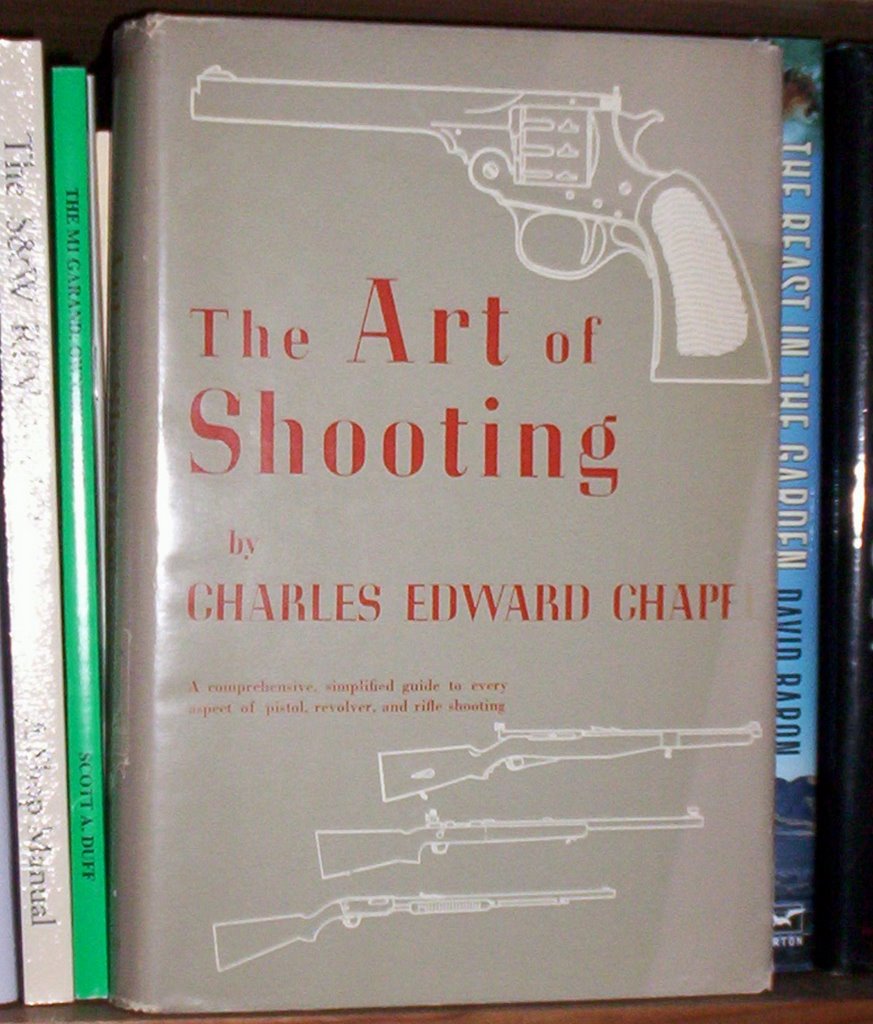 My Copy of The Art of Shooting
I haven’t done a gunnie book review for awhile, and because I’m still home sick with a crud that won’t go away, I’ve got plenty of time to read. That is, I read until my eyes get tired, then I get bored, read again until my eyes get tired, and repeat the cycle. What is it about flu that makes your eyes hurt? It’s just not fair (using my most petulant, little girl voice). Well, enough about me, here’s a discussion about a book that’s almost as old as I am.
Charles Edward Chapel was a prolific gun writer in the 1950s and 1960s. A former Marine and aeronautical engineer, he once served in the California State Legislature. His passion was gun writing and he was very good at it. A list of his books would only get boring to the reader, but here is what Amazon.com lists under his name.
He wrote Guns of the Old West, which is still an authority on the topic and has been republished over 40 years after he wrote it. He wrote about cleaning and caring for guns, shooting rifles, pistols, and shotguns, and every thing else dealing with guns. He even wrote a book with an intriguing title, The Boys Book of Rifles. Try to get that past a publisher’s desk now.
I picked up The Art of Shooting in a used bookstore. I recognized the author’s name from a book or two my father owned. I thought it would be worth reading and I was right. “The Art of Shooting” is a combination of two earlier books, Simplified Rifle Shooting and Simplified Pistol and Revolver Shooting. I haven’t read the earlier books, so I’m not sure how much he updated them for the single volume published in 1960.
The Art of Shooting contains excellent information on shooting. It’s a sport that doesn’t change in its bare essentials; sight alignment, sight picture, trigger squeeze. Even though we have many new gun sports that didn’t exist in 1960 (Sporting Clays, Cowboy Action Shooting, Practical Pistol, etc.), there are still many things in his book that are useful for us to learn. Many rifle shooters, for instance, have forgotten the art of the sling. There’s a section that will reacquaint you with that useful device.
Of course, there are anachronisms. There is little mention of women as shooters and Chapel seems to go out of his way to say things like “…men on the firing line.” I think Chapel would have welcomed women shooters. He mentioned that a .22 rifle is an ideal first gun for a young boy or girl. However, he doesn’t go out of his way to encourage women to take up shooting.
Chapel wrote at a time when gun rights were not under siege. As an NRA member, he includes a chapter on advantages of NRA membership. Not once does he discuss protecting our gun rights as a benefit of NRA membership. It simply wasn’t an issue YET.
Even a simple, declarative, true sentence like, “The right to own firearms and acquire skill in their use is a basic part of the democratic way of life.” (Preface, p. 7) would need to be hedged with an argument today simply because today’s reader might question that position. Chapel doesn’t shy away from the fact that marksmanship is an important skill for future soldiers who may have to kill another human being.
There are a couple of things on which I part company with Mr. Chapel. For instance, he talks about how to shoot running deer even at long yardage. I hunt and would not take a shot like that because there’s too much risk of injuring the animal and only a snowball’s chance of making a quick, clean kill. Still, his discussion of hitting moving targets with a rifle is interesting and would be useful in other contexts.
Chapel writes well with a gift for making a complex topic easy to follow. The Art of Shooting is written for a non-expert on guns. There are parts that assume the reader has no knowledge and I admit I got a little tired of the section on the history of firearm development. Still, I learned a little bit more while reading it.
If you find yourself laid low with a virus and you want to read clear gun writing, buy yourself a used copy and enjoy stepping back in time. You’ll find yourself in a time when a prolific gun writer and avid shooter could get elected to the California State Legislature.
Tuesday, February 21, 2006
Prayers For the Assassin
In a previous post I talked about my weekend and winning a gun auction. My other big accomplishment of the weekend was reading Robert Ferrigno’s Prayers for the Assassin. If you haven’t heard of it, here’s a synopsis. In 2015, Washington, D.C. and New York City were destroyed by terrorist nuclear bombs and Mecca was hit by another one. Investigators tracked the terrorists to Mossad.
The psychological shock and ensuing economic problems led to most of America becoming an Islamic Republic. Nevada split off to become a banking and “sin” center for the nation. The southeastern states formed an independent nation of Bible belters. The Mormons carved out an enclave in Utah and part of Idaho. Catholicism is reluctantly tolerated, but its adherents are in a dhimmi status except in Southern California where they are a minority but get more respect. Civil war had raged, but a reluctant peace has ensued.
There are tensions between Muslims as some divide into fundamentalists while others identify themselves as “moderns.” Of course, fundamentalists try to bring the moderns to the “true faith.” Women have a diminished role and society’s technological prowess and infrastructure are deteriorating.
In 2040, a historian and niece of the head of the Islamic state’s intelligence services uncovers evidence that the bombs may not have been Mossad’s doing. The book follows her and her lover while they try to find proof and try to dodge an assassin sent to find them.
That’s enough about the plot. If you want to read it, you’ll probably enjoy it.
Now, a gunnie’s point of view. There’s one mention of the Second Amendment. The mullahs and imams realized that they couldn’t allow an armed populace and made owning handguns a capital offence. Many people grumbled, but they turned their guns in anyway. The book mentions that a lot of people fled the Islamic Republic for the Bible Belt and Nevada, so I imagine (hope) that many gunnies made that trek. There are few mentions of how people in the Bible Belt live although Vegas is, well, Vegas.
I couldn’t put Prayers for the Assassin down and read it in about two days. I highly recommend it for a variety of reasons not the least of which is its role as a cautionary tale.
The psychological shock and ensuing economic problems led to most of America becoming an Islamic Republic. Nevada split off to become a banking and “sin” center for the nation. The southeastern states formed an independent nation of Bible belters. The Mormons carved out an enclave in Utah and part of Idaho. Catholicism is reluctantly tolerated, but its adherents are in a dhimmi status except in Southern California where they are a minority but get more respect. Civil war had raged, but a reluctant peace has ensued.
There are tensions between Muslims as some divide into fundamentalists while others identify themselves as “moderns.” Of course, fundamentalists try to bring the moderns to the “true faith.” Women have a diminished role and society’s technological prowess and infrastructure are deteriorating.
In 2040, a historian and niece of the head of the Islamic state’s intelligence services uncovers evidence that the bombs may not have been Mossad’s doing. The book follows her and her lover while they try to find proof and try to dodge an assassin sent to find them.
That’s enough about the plot. If you want to read it, you’ll probably enjoy it.
Now, a gunnie’s point of view. There’s one mention of the Second Amendment. The mullahs and imams realized that they couldn’t allow an armed populace and made owning handguns a capital offence. Many people grumbled, but they turned their guns in anyway. The book mentions that a lot of people fled the Islamic Republic for the Bible Belt and Nevada, so I imagine (hope) that many gunnies made that trek. There are few mentions of how people in the Bible Belt live although Vegas is, well, Vegas.
I couldn’t put Prayers for the Assassin down and read it in about two days. I highly recommend it for a variety of reasons not the least of which is its role as a cautionary tale.
Wednesday, February 09, 2005
A Gun Nut Book Review
Last night, I finished Gunpowder by Jack Kelly. Probably for marketing, the book is subtitled twice, "Alchemy, Bombards, & Pyrotechnics: The History of the Explosive that Changed the World." Well, you can't complain that the entire title is misleading.
The book starts with the invention of gunpowder in China, and ends when "smokeless" powder largely supplanted it. Between the beginning and the end, Kelly includes many fascinating stories about gunpowder, its use, and the guns we developed to focus its power. The Chinese, despite myths to the contrary, did use gunpowder in war (p. 8).
Still, the Europeans refined its use. They developed huge cannons called bombards, built in the same way a cooper builds barrels. They took strips of iron, similar to barrel staves, bound them around a wooden pole, pounded until the strips meshed together, shrunk hoops around the staves for strength, and removed the pole (p. 41). Of course, every gun today has a barrel even though its made very differently from the way a keg is built.
Bombards gave way to bored barrels that led to smaller, more maneuverable guns even as powdermen improved their product. They figured out that adding a little moisture to the dry powder helped it resist humidity and made it safer to make (less explosive fine powder collecting in the air). A once preferred liquid for the mix was the urine of wine drinkers, particularly that of bishops (p. 61) although later powdermen used distilled water. Interestingly enough, urine contains the precursor chemicals that help saltpeter (a key ingredient of gunpowder) form and the urine of drinkers contains even more of those chemicals (p. 35).
Leonardo da Vinci designed a number of military items, including the wheellock, the ancestor of the flintlock (p. 76).
Besides these interesting facts, the book has a couple of statements that made me stop and ponder. Kelly states that gunpowder proved to be an equalizer. Armed commoners could shoot down a noble knight (p. 77). We gunnies sometimes say that armed people are citizens and unarmed people are subjects. Gunpowder may have helped develop the concepts that led to democracy.
A downside to the use of gunpowder was its cost and that of the weapons that used it. In order to equip and control the new armies, governments began centralizing and establishing more sophisticated means of taxation (p. 78). Always have to take the bad with the good.
Gunpowder helped lead to modern chemistry. Early chemists like Robert Hooke found out that gunpowder can burn in a vacuum. He realized that there was something in gunpowder that supplied its own substance that allowed burning (p. 112). Old ways of thinking fell to new ways. Over the course of a century another chemist named the element oxygen (p. 167).
Thus, without gunpowder arguably we would not have had democracy, the modern state, and modern chemistry. Tell that to your anti-gun acquaintances.
The book discusses how new powders supplanted the old. Nitroglycerine, nitrocellulose, and "smokeless" powder almost overnight ended gunpowder's military and peaceful uses. Today, black powder shooters still use it, but its most significant use is in fireworks.
The author is not preachy although he sometimes decries the carnage that gunpowder has wrought. It is a great addition to my firearms library and the author, also a novelist, writes well and I found the book entertaining. Of course, anything about guns is entertaining to me so your mileage may vary. I recommend it.
The book starts with the invention of gunpowder in China, and ends when "smokeless" powder largely supplanted it. Between the beginning and the end, Kelly includes many fascinating stories about gunpowder, its use, and the guns we developed to focus its power. The Chinese, despite myths to the contrary, did use gunpowder in war (p. 8).
Still, the Europeans refined its use. They developed huge cannons called bombards, built in the same way a cooper builds barrels. They took strips of iron, similar to barrel staves, bound them around a wooden pole, pounded until the strips meshed together, shrunk hoops around the staves for strength, and removed the pole (p. 41). Of course, every gun today has a barrel even though its made very differently from the way a keg is built.
Bombards gave way to bored barrels that led to smaller, more maneuverable guns even as powdermen improved their product. They figured out that adding a little moisture to the dry powder helped it resist humidity and made it safer to make (less explosive fine powder collecting in the air). A once preferred liquid for the mix was the urine of wine drinkers, particularly that of bishops (p. 61) although later powdermen used distilled water. Interestingly enough, urine contains the precursor chemicals that help saltpeter (a key ingredient of gunpowder) form and the urine of drinkers contains even more of those chemicals (p. 35).
Leonardo da Vinci designed a number of military items, including the wheellock, the ancestor of the flintlock (p. 76).
Besides these interesting facts, the book has a couple of statements that made me stop and ponder. Kelly states that gunpowder proved to be an equalizer. Armed commoners could shoot down a noble knight (p. 77). We gunnies sometimes say that armed people are citizens and unarmed people are subjects. Gunpowder may have helped develop the concepts that led to democracy.
A downside to the use of gunpowder was its cost and that of the weapons that used it. In order to equip and control the new armies, governments began centralizing and establishing more sophisticated means of taxation (p. 78). Always have to take the bad with the good.
Gunpowder helped lead to modern chemistry. Early chemists like Robert Hooke found out that gunpowder can burn in a vacuum. He realized that there was something in gunpowder that supplied its own substance that allowed burning (p. 112). Old ways of thinking fell to new ways. Over the course of a century another chemist named the element oxygen (p. 167).
Thus, without gunpowder arguably we would not have had democracy, the modern state, and modern chemistry. Tell that to your anti-gun acquaintances.
The book discusses how new powders supplanted the old. Nitroglycerine, nitrocellulose, and "smokeless" powder almost overnight ended gunpowder's military and peaceful uses. Today, black powder shooters still use it, but its most significant use is in fireworks.
The author is not preachy although he sometimes decries the carnage that gunpowder has wrought. It is a great addition to my firearms library and the author, also a novelist, writes well and I found the book entertaining. Of course, anything about guns is entertaining to me so your mileage may vary. I recommend it.
Wednesday, January 05, 2005
Imagine No Guns-A Book Review
Alphecca has a post about an old Dave Kopel article in the National Review. The article imagines what would happen if there were a world-wide gun ban. Basically, such a ban would be ineffective for many reasons.
The article and post got me thinking about a couple of novels I read recently and thought I would share them with you. A theme in both is to force characters to rely on brains and brawn because guns no longer worked or became unavailable. The author of both books is S.M. Stirling and both are science fiction for lack of better term.
The first novel, Island in the Sea of Time imagines that Nantucket Island is somehow transported to the Bronze Age (remember "willing suspension of disbelief" for the rest of this post). The author is not satisfied with making things too easy for the displaced Yankees by allowing them to have guns.
The townspeople are under a great deal of stress are there are suicides and murders. The new government decides to round up guns until such time that people return to their senses. One character opposes this gun ban, but it goes forth anyway and guns and ammo are confiscated and put in a warehouse. A religious group ends up burning the warehouse and destroying most of the firearms that came back with the time travelers. So much for gun control, and the lesson I took from this is: if I ever find myself in the Bronze Age I will never allow myself to be disarmed (since I won't be visiting the past anytime soon, I will follow this lesson anyway).
The book talks about trade, wars with Bronze Age natives, internal battles among the time-warped Nantucketeers. It even has a group of moonbats that get a serious comeuppance.
The author does not seem to be a gun-grabber type who wants guns to disappear. The destruction of most guns is a plot device. The book is still interesting for all that and I give it four out of five stars. There are two other books in the Nantucket series that I have yet to read.
Stirling followed this book with Dies the Fire. It is not a sequel instead it explains what happened to the rest of the world when Nantucket slipped into the past. The transposition of Nantucket took a lot of energy and there is no longer electricity in the entire world. Certain chemical reactions no longer work either and among these is gunpowder.
Guns are clumsy clubs now. One young woman thinks this is the best news she ever heard until the book's hero tells what will happen--people will arm themselves with everything they can find. Bows and arrows. old swords, knives, homemade spears, everything that man has figured out how to use to kill another man. Ironically Renaissance Fair-type geeks have a head start in this new society. A history professor and sword fan becomes the book's "Dark Lord." Again, the book requires a healthy willing suspension of disbelief and if science fiction is not your cup of tea, don't read it or its companions.
As a gun nut, I liked the fact that the author depicted a world that was actually more violent without guns. I think he is right in this. I would hate to live in a world without firearms since Bill and I collect them, use them for recreation, and keep and bear them for self-defense.
The article and post got me thinking about a couple of novels I read recently and thought I would share them with you. A theme in both is to force characters to rely on brains and brawn because guns no longer worked or became unavailable. The author of both books is S.M. Stirling and both are science fiction for lack of better term.
The first novel, Island in the Sea of Time imagines that Nantucket Island is somehow transported to the Bronze Age (remember "willing suspension of disbelief" for the rest of this post). The author is not satisfied with making things too easy for the displaced Yankees by allowing them to have guns.
The townspeople are under a great deal of stress are there are suicides and murders. The new government decides to round up guns until such time that people return to their senses. One character opposes this gun ban, but it goes forth anyway and guns and ammo are confiscated and put in a warehouse. A religious group ends up burning the warehouse and destroying most of the firearms that came back with the time travelers. So much for gun control, and the lesson I took from this is: if I ever find myself in the Bronze Age I will never allow myself to be disarmed (since I won't be visiting the past anytime soon, I will follow this lesson anyway).
The book talks about trade, wars with Bronze Age natives, internal battles among the time-warped Nantucketeers. It even has a group of moonbats that get a serious comeuppance.
The author does not seem to be a gun-grabber type who wants guns to disappear. The destruction of most guns is a plot device. The book is still interesting for all that and I give it four out of five stars. There are two other books in the Nantucket series that I have yet to read.
Stirling followed this book with Dies the Fire. It is not a sequel instead it explains what happened to the rest of the world when Nantucket slipped into the past. The transposition of Nantucket took a lot of energy and there is no longer electricity in the entire world. Certain chemical reactions no longer work either and among these is gunpowder.
Guns are clumsy clubs now. One young woman thinks this is the best news she ever heard until the book's hero tells what will happen--people will arm themselves with everything they can find. Bows and arrows. old swords, knives, homemade spears, everything that man has figured out how to use to kill another man. Ironically Renaissance Fair-type geeks have a head start in this new society. A history professor and sword fan becomes the book's "Dark Lord." Again, the book requires a healthy willing suspension of disbelief and if science fiction is not your cup of tea, don't read it or its companions.
As a gun nut, I liked the fact that the author depicted a world that was actually more violent without guns. I think he is right in this. I would hate to live in a world without firearms since Bill and I collect them, use them for recreation, and keep and bear them for self-defense.
Subscribe to:
Posts (Atom)